All about the Sauce…

Pimp my  plate – Virgil Evetts

It’s all about the sauce, don’t you think?  Well it is for me.
Although I’m mostly a dry food person, I really like a little bit on the side, so to speak, just to liven things up.

A good sauce or condiment [a word which thanks to memories of my puerile adolescence will always be sniggeringly associated with prophylactics] should be a complimentary thing, not a mask to the flavours it’s paired with.  A little heat maybe, some sweetness, some sharpness and texture . Its matter of accent I suppose.  I’m obviously not alone in my fondness for a dollop; as all cultures have their many and varied sauces, salsa, pickles, relishes, pastes, pesti and so on.  Just consider the vast tracts of real estate given over to this theme in supermarkets the world over.

I think our taste for such embellishment stems for that age old human need to personalise everything and in the case of masochistic chilli sauces, to make a statement of bravado and machismo, kind of like pimping out your ride.  They allow us all a form of expression where even the most narrow minded can show a willingness to step out of the meat and three confines of supper-time suburbia.

We’re fiercely loyal and more than a little parochial when it comes to our sauces too.  Once we get hooked [and that addiction is more often than not passed down from our parents] it’s generally for keeps.

Until not so long ago down here in the colonies that mostly meant Watties tomato sauce, various so-so brands of Soy, Worcester sauce,  malt vinegar [which tastes like acidic sweat to me] and maybe plum sauce if Nanna was handy with a preserving pan.

Being as we are, about 2 million miles from anywhere worth visiting,  we New Zealanders have taken advantage of cheap[ish] airfares in recent years and made something of habit of getting out of the backblocks and going off to and see and perhaps more importantly, taste the world.  So our tastes are now somewhat fluid; we are by and large far more outgoing in our eating habits than most Europeans, who stick doggedly to their admittedly rather decent national cuisines.   For example, hands up if you have a bottle of Thai sweet chilli sauce in the pantry.  As I suspected.  I’ll also hazard a guess that this would have been a different story 15 years ago.  Not much gives me hope about our species anymore, but the seemingly mundane arrival of a spicey, sweet South East Asian standard in the cooking vernacular of middle New Zealand fills me with a dram of optimism. It’s kind of like the condiment equivalent of the recent US election results. A pleasant surprise and not something you could have predicted a decade back. Ok so it’s a grossly stretched analogy but I’ve been desperate to politicise things lately and I seem to divide people enough as it is without flying my local colours.

Rather disturbingly on a recent trip to Thailand I found a bottle of Worcester sauce made right there in the land of reclining Buddha’s [or is that Cambodia?] under official licence.  Nothing per se against a splash of Worcester on my poached egg, but the thought of Thais splashing it across their shame-inducingly elegant food bring sons a panicky weakness in my bowels. Maybe it’s just made for all those Brits who loiter about Phuket complaining about the heat and the prevalence of ‘foreign muck’.

Anyway, the point I was getting at is that the sauce preferences of an average household in any given country speaks volumes of the national and possibly local food culture.  In most western spots you don’t even need to check out the sauces. Just stop by at the local purveyor crud and check out the chips on offer. It’s a pretty good indicator that a flavour has been fully accepted by a people when it appears as a potato chip; think pesto, sweet chilli, tzatziki etc. The recipe for artificial Hummus flavour must be causing industrial food chemists many sleepless nights.


So anyway, down to business. Something you can make and hopefully enjoy as much as I do [quite a bit].  I’m not about to offer up yet another rendition of sweet chilli, or ketchup or Piccalilli [heaven forbid]. Plenty of those about the place already and why bother when the ready-mades are so very… adequate?  Besides, I hate my house reeking of vinegar.

No, Instead I’m going to give you just one sauce, of my own invention [I think].  It takes but moments to make and doesn’t require any cooking

Red Sauce

Call me unimaginative, but this is the only name we know this stuff by in our house.  It’s a pretty accurate name though as the sauce is a pleasing red/orange colour and has a very red flavour, if you know what I mean.  Its tres tres summery too; being largely composed of capsicum and despite its creaming, silky texture is not especially fatty.   Think of a light mayonnaise with a warm, smokey capsicum flavour  but is miraculously free of eggs.  It’s essentially a salad sauce if there is such a thing and goes particularly well with cold chicken, on crisp leaves, waxy new potatoes and asparagus… you get the idea.  I’ve finished off a few batches on crusty fresh baguette too.


Char-grilled Red Peppers [capsicums] -preserved or home made

Extra Virgin Olive Oil

White wine vinegar

Spanish smoked paprika

Ground dried chilli

salt

To a blender or food processor add skinned, char-grilled capsicums. For each whole capsicum add 1 teaspoon Spanish smoked paprika and ½ teaspoon white wine vinegar. Blend on high and start drizzling in the EVO until the sauce takes on a thick and creamy appearance. Taste, season with salt and chilli and then blend again for a moment or two. If too thin add a little more oil while blending.    This stuff keeps well in the fridge [we practically lick the bowl clean, so storage has never come up] but it may separate at room temperature. Another spin in the blender should sort it out.


Now you may notice that I haven’t laid in to the nations favourite sauces.  I suspect doing so would open a whole hornet’s nest of angry, buzzing antagonism. Instead I thought it would be far more fun to let you name [and shame] you’re favourite and most hated sauce sand condiments. So let’s have it then; Sauces: the good the bad and the fugly…


Kitchen Myths and Pretensions

Kitchen myths and pretensions – Virgil Evetts

Cooking is my favourite thing. It calms me when I’m stressed and excites me when I’m down.  I think about food when I open my eyes each day and it’s often my last thought as I drift off at night. It brings me true joy.

This is why I’m so offended by the sheer pretentiousness and/or laziness of so many perpetrators of the ‘art’. The preening, superior tones of the matriarchy and patriarchy of cooking célèbre have created an image of middleclass twattery that is applied to all of us who obsess about dinner. Such characters do exist, in droves sadly, but it’s a faddish thing. Chances are they will wash away on the next tide of domestic twee. The current global financial crises should take care of a good number of them.

The fact that I am a hopelessly middleclass twat is quite separate from my kitchen fetishism. When it comes to food I’m actually quite down to earth, as I suspect are a great many of us who are branded with the rather icky handle of ‘foodie’. We occupy a middle ground of loving good produce, and tradition, being deeply respectful of and excited by innovation, but still mindful of practicality and economy. Does that sound about right?

So, this week I’d like to dispel a number of common kitchen myths and pretensions that have been on my mind of late. 

 Copper bowls

Don’t they look pretty? So ‘rustic, so very country kitchen’. And of course you need one of these for whisking egg whites. How else will you get perfect stiff peaks?

By using a whisk in any old bowl, be it plastic, metal, ceramic or whatever.

Yes, copper looks nice [if you’re into that sort of thing], and it might make a slight difference to the eggs I don’t really know. Necessary?  No way.

 Extra virgin olive oil

Beautiful stuff this. It can be the saviour of salad, a revelation on good bread. It’s also probably the most abused and over-prescribed ingredient of the last 100 years. Repeat after me ‘EVO aint for cooking’.

Heating destroys much of the oils flavour and any remaining subtlety is lost in the rest of the dish. TV chefs with great jugs of EVO [no double entendre intended] are simply appeasing the show’s art director. Don’t take it as advice.

For frying or any other actual cooking treat EVO with the respect it deserves and use a lower grade of oil. Try, however, to avoid olive pomace oil; this is extracted by some ghastly chemical procedure and it tastes like it too.

 Flavour Shakers

Allegedly invented by and branded with the name of you-know -who [he of the dodgy Essex accent].
Come on. Seriously?  This is up there with steak knives that cut through tin cans on the list of pointless kitchen clutter.  The flavour shaker does nothing that can’t be done better in a mortar and pestle, food processor or with a knife for that matter.


European Wine
Now don’t get me wrong. Some of the finest wines around still hail from Europe.  But don’t take country of origin as a sign of superiority.  In my experience, a lot of midrange NZ wine is rather a lot better than far pricier French and Italian equivalents.  Also, quality aside, those of us who have spent a number of years mostly drinking local plonk may find European wines, especially whites, rather sulphurous. This is because EU regulations allow a higher preservative level in wine than is the norm down our way.  It varies from wine to wine and you do get used to it, but eggy-ness isn’t something I chase in my wines.


Cooking Wine
It’s often said that you shouldn’t cook with any wine you wouldn’t drink. Well, I’ve made a point of putting this rather bold statement to the test. I’ve cooked with some remarkably bad wines and some very decent ones too. And my conclusion?  It doesn’t make a jot of difference. By the time you have subjected a wine to heating and the addition of any number of  flavours, all wines taste [aside from the obvious difference of red or white] pretty much the same. Dare I say it but a cask each of dry white and red is a useful addition to the pantry. There are exceptions to this. Some recipes hang off the flavour of a wine [e.g. my asparagus risotto recipe in Perfect day food] , so as always use your discretion. But generally speaking, don’t waste good wine on the pot or tepid acquaintances. Drink it down with great food and only the very best of friends.


Tuscany
Enough with this region already.  Ever since Frances Mayes published her patronizing, dull record of restoring a Tuscan farmhouse [Under the Tuscan sun], the whole world has been obsessed. In food circles, the declaration made in Toscana is seen as some sort of guarantee of excellence. It may well be, but Italy has 19 other regions, all with ancient and intriguing food heritages and yielding fabulous produce and artisan products.  I’ve eaten some stupendous stuff in Tuscany, even better in nearby Emilio Romagna; but personally I think the food of the poorer, Southern regions is more interesting, for its sheer exuberance and creativity. Out of hardship comes innovation I guess.


Organic tastes better
Does it though? Not according to most blind taste tests. Beware the placebo effect. Just because we are told something tastes ambrosial doesn’t mean it actually does. The benefit of eating organically is more an issue of health and ethics. Organic practices have a lower environmental impact [but still leave their mark] than conventional methods, and such produce is less likely to contain harmful pesticide and fertilizer residues. In my books that’s more than reason enough to go organic. Certainly, your average organic chicken and pork will taste a good deal better than their bedraggled and abused factory-farm counterparts, but it’s largely down to lifestyle and diet, not the organic treatment per se.

So, before you set upon me in a dark supermarket aisle and tear me a brand-new and probably superfluous orifice, yes I do whole-heartedly support organic farming and horticulture; BUT I don’t accept the blanket claim that such produce automatically tastes better than bog standard.   It might do, but don’t count on it.


Salt
I love Maldon salt. That glassy texture and sharp salty tang plays so beautifully on the tongue. A pretty decent approximate is being churned [or sieved] out locally now by Dominion Salt.  It’s often the making of a good salad and a fine embellishment to many a rustic lunch. But that’s about where our love affair with sea-salt, be it flakes, rock or the lovely fleur de sel, should end. I’m usually the last person to advocate adulteration, but in the case of salt you really should be cooking with iodised. New Zealanders have among the lowest iodine intakes in the developed world [which is tragic considering we are surrounded by oceans brimming with fish]. If you’re determined to persevere with the whole sea-salt only thing, may I suggest you do a Google image search for ‘goitre’?

 Fresh pasta
There is a funny notion out there that fresh pasta is the only real pasta. Dry, on the other hand is just a poor substitute, favoured by the plebs who don’t know any better [bless them].Not true. They are, and always have been, completely different beasts. In much of Italy, dry pasta [pasta secca] is the norm. It’s very adaptable, depending on the shape and lasts forever in the pantry. It’s made with nothing more than flour [semolina or durum] and water. Dry pasta is no-nonsense, toothsome stuff and stands up well to Southern Italy’s salty, tomatoey, garlic and chilli-laden sauces

Fresh pasta on the other hand [pasta all’uouva], is more of special occasion sort of thing. Made with flour, eggs and water it’s a delicate, flighty creature, favoring dairy and meat- based Northern Italian-style sauces like Ragu all’Bolognese, but sulking into the background under too much tomato.

With the right brand [or better still home-made in the case of fresh pasta] and the right sauce, both can be the stuff of true contentment; but to my mind dry is a safer choice for the jaded weeknight cook.


Coffee

Coffee machine manufacturers have done a very good job of convincing that most image conscious of urban addict – the coffee drinker – that the only way to enjoy good coffee at home is with a very pricey piece of bench top clutter. Lies and propaganda. In the right hands, the old fashioned Alzheimer’s-baiting Moka pot can squeeze out a damn good shot or two. It’s all in the method. To get a café-quality shot from a Moka pot follow these instructions very carefully:

  1. Fill the water compartment to the valve.
  2. Fill the coffee compartment completely with espresso-grind coffee. Tamp down firmly.
  3. Screw the pot together and place on the heat.
  4. Lift the lid and keep your eyes glued to the pot.
  5. Just before the spluttering and squirting comes over all a-fluster, about 2-3 shots [depending on the pot size] of syrupy, inky-black coffee should ooze from the spout.

This is like the first pressing of olive oil, precious, flavoursome and ultra strong. Pour this elixir off and drink either neat [if you’re into main-lining caffeine] or dilute with warm, or preferably steamed, milk. This ‘first pressing’ has all of the sweet, almost chocolaty qualities of good coffee with none of the harsh, woody, burnt flavours that often dominate from a Moka pot. The coffee that follows, the second pressing if you will,  is best used in iced coffee, granita or boiled down for use in gelato.

I can offer you no useful advice for plungers or peculators. Here be dragons.


I think that will do for now. There are many other ‘consumer-beware’ proclamations and assertions that need to be stamped out – myths about fats, ceramic Vs induction Vs gas, stupid cooking buzz-words etc etc.


I’ll leave it up to you to add to my list…

Home Orchard Essentials

 Six of the best – Virgil Evetts

Garden centres are just like supermarkets. That apparently friendly, welcoming layout is carefully designed by evil retail psychologists, who employ all manor of arcane trickery to manipulate the hapless shopper into leaving with a trolley full of stuff they didn’t want.  This mental onslaught is even worse in spring, when the big-boys [and girls I imagine] of the nursery world go all-out to dazzle us with the latest in high-health this and grafted everything.

You really need to look beyond all the glossy foliage and dubious promise of bumper crops. You need to work out what you really need and know what will actually work. My experience is pretty Auckland-centric (I know, an unforgivable sin), but my own trials and legion of errors have helped shape my garden into a tight little food factory; churning out plenty of things I can’t buy easily or affordably. For most of us it’s never going to be practical to live entirely off our backyard bounty. Unless you have a lot of time on your hands, a fondness for backbreaking labour and a very big backyard, it’s just a Felicity Kendal pipe-dream. You can however supplement your diet and enhance your cooking with some truly fabulous home-grown produce without too much hard graft.

I’m all about lists. They allow me to write in short, opinionated sound bites and help contain my tendency [which you may have noticed] to via off on meandering tangents. So, I’ve put together a list of essential fruit trees for the home garden. I grow a lot more than these 6, but these are the ones that I really couldn’t live without.  I know, it’s not the traditional time to plant most of these trees [although you can].  But it is time to starting looking around your neighbourhood to see what trees are flowering and fruiting well and will therefore flourish in your own scaled-down Eden. 

Before I proceed, a little ‘don’t blame me’ waiver: All my experience is based on Auckland’s mystery-prize of a climate, volcanic soil and the use of vast quantities of compost. I do things mostly organically, but have been known to throw the odd handful of Nitrophosphate about the place. I don’t use pesticides, but probably would if hot soapy water didn’t work so well. I pay no attention whatsoever to the moon or stars when planting, but feel free if it helps balances your chakras. In other words, I garden for the end results, try not to poison the soil or myself along the way, but don’t get all kaftan and mung bean about it.

Lemons

Should be the top of any cooks must-have list. If you don’t use this fruit regularly, wake up. Lemons are undemanding trees, they like warmth, sun and a bit of food. For that true lemon flavour you need to squeeze past that big display of Meyers [a cold-hardy hybrid between a lemon and an orange much pushed by garden centres] at your local nursery and search out a true lemon such as Yen Ben or Villa Franca. For something a little more adventurous try a Ponderosa. These monsters can reach a kilo or more per fruit and have thick, fragrant peel, perfect for Glace. Like all citrus, lemons are available on gangly, grow-em big Trifoliata root stock, or the spiky, dwarfing Flying Dragon. One or the other will suit your situation. Barely a day goes by where I don’t use lemons for something: Salad dressing, marinades, serving with fried food, in curries, in cocktails. Simply indispensable.

Peaches

Rufus Wainwright [Canadian singer song-writer] is quoted as saying he doesn’t care for peaches on account of their overt heterosexuality [he claims to prefer bananas]. Disappointingly poor taste for such a chi-chi gay man. 

If you’ve never eaten a freshly picked, sun-warmed peach, you’ve never eaten a peach at all, and frankly you haven’t lived much either. In my experience, not even the best store-bought version can compare with the fuzzy fragrance and obscene juiciness of a home-grown peach. Anyone with a garden or even a large trough has room for a peach tree. But do some home work before you buy. Peaches can be fussy little buggers, so you need to find one actually that works in your area. The good people at Koanga are full of useful advice on such matters. Of course you then have to decide on what sort of peach you want- clingstone, freestone, white fleshed, yellow fleshed, red fleshed, nectarine [just a fuzz-free peach according to the geneticists]. I can highly recommend the questionably named Black Boy- a luscious, winey, red fleshed peach, and Orion, an heirloom white fleshed from Koanga that fruits to excess and ripens before Christmas At their best peaches are too damn good for anything other than eating au naturale, on a sunny day or made into a perfect, icy Bellini, the divine champagne and white peach cocktail from Harry’s Bar in Venice.


Apples

Well they may not have the raw, sex appeal of a peach, but a good apple tree more than pays its rent. As with the above, you need to find one that suits your locale, and personal taste.  My smallish braeburn churns out around 40 Kilos of fruit per year with very little effort on my part. Tossing a bit of food their way from time to time and hanging a Codling moth trap near by is pretty much all it takes.  I press my entire crop into wine each Autumn, but I suppose you could even eat them. Apples will fruit well everywhere in New Zealand, and Nurseries such as Koanga and Diacks offer dozens of different varieties, often with charmingly absurd names – Slack My Girdle, Nonette Bastard and Brown Snout, to name but a few.

Figs

There’s evidence a-plenty that figs were once a popular table fruit in New Zealand – just count the number of mature trees in Northern parts of the country.  But  for some reason they fell out of favor. A whole generation forgot all about figs. The good news is they appear to be clawing their sweet, perfumed way back into our hearts and gardens. As a commercial fruit, figs are the stuff of nightmares. They don’t ripen at all once picked but tree-ripened fruit are so tender and squishy that they can barely contain themselves on the branch let alone in freight. So unless you grow your own, you’re unlikely to ever taste a perfectly ripe fig.  These trees like more warmth than the above entries but have been known to fruit well against a sunny wall in Christchurch, so don’t despair if you live down south. They fall into two main types- white fleshed and red fleshed, with a few pink procrastinators in between. Personally I find white fleshed figs too cloyingly sweet. It’s hard to tastes much beyond the sugar. A good red fleshed fig however, can be rich, flavoursome delight, with notes of strawberry and honey and a lovely figgy fragrance. Better still, these trees thrive on neglect. Once they get their roots down deep, they can handle drought easily, and are very happy in containers.

Damson

Disregard if you’re not into preserves because this pretty little plum is damn near inedible raw. However as jam, paste,  in plum sauce,  liquors and so much more, Damsons have the richest, truest plum flavour you’re even going to find. In spring the trees are blanketed in snowy white, honey scented blossom followed by enormous crops of frosted blue plumlets. The fruit look so good on the tree I can hardly bare to pick them.  I don’t normally have patience for fruit that require processing but Damsons get a permanent pass. They grow and fruit prolifically all over New Zealand and are small manageable trees worthy of a corner in every Foodlovers garden.


Kaffier Lime

Not strictly a fruit tree as it’s not really grown [in New Zealand] for its fruit, but I’d be lost without this fiendishly spiky beast. The leaves of Kaffier lime have a truly unique fragrance and flavour. Sort of citrusy, but mostly just kaffier limey. I guess you could sum it up by saying they taste like Thai food. These are very much the South East Asian equivalent of bay leaves. They are thrown into soups, curries, salads and stir fries. They grow outdoors quite happily in Auckland and in containers in the cooler districts. You might even get the odd wrinkled, green-brain fruit if you’re lucky. What these lack in looks [and juice] they make up with pungently potent zest.  Thanks to their vicious, 5 cm long needle-sharp spines; they make damn fine burglar deterrents too.


So, if you’re not growing at least one of these trees yet, I urge you, with all my flavour obsessed little heart to do a bit of research and find a cultivar that will deliver the goods in your own little corner of Heaven.

And if you have a personal list of home orchard essentials, I’d love to see it…

All contributors to this post will automatically be entered into the draw to win one of 5 copies of New Zealand Gardener Special Edition – Homegrown 3

Cooking with Chilli

 Burning with Desire – Virgil Evetts

 Despite being full of promise, and all that la-de da, spring is a tricky beast when it comes to dressing and eating- Over exuberant salads are still bone-chilling but a pot of pea soup feels like molten ships ballast. What to do?

 Break out the chilli, I say. The beauty of this fierce-bad fruit is its ability to give warmth without too much substance and to marry so beautifully with breezy tropical accents such as lime, pineapple, coriander and mint.

I’m a total freak for chillies. Being raised by a chef, I was exposed to their pleasures at a tender age, and now eat them in quantity [and intensity] all year round; but I think they’re particularly welcome during the cusp seasons of spring and autumn.

I do however appreciate that not everyone is a fan, and that to the polite of palate they can be downright painful. So I’ll go easy on you.

Firstly, a buyers guide to common chillies and then a recipe- Chilli con Carne, that suits the season; it’s as light on the heat as you want it to be, warming but not weighty and hopefully leaves you feeling sated.  

I can’t however offer you any useful advice in the spring clothing department.  I have very little sense of seasonal suitability of dress. I once wore jeans and a t-shirt on the Whakapapa chair-lift in July. It’s cold up there.

 Safety briefing. Know thine enemy…

It’s impossible to reliably list the heat of any chilli as this can vary from season to season or even between fruit on the same bush.

So using the Scoville scale [the official measure of chilli heat], and my own experience, I can give you a reasonable idea per common variety; but the only way to be sure is the taste test. Yup, stick that tongue out and stop being a big ol’ ‘fraidy cat. The alternative may be howling children and gastric violence in the smallest room. Seriously though, NEVER use chillies until you’ve worked out their individual heat. To lower the burn factor, remove the seeds and membrane. This is where the worst heat resides. Use milk, not water to sooth a chilli-singed mouth and toothpaste on seared lips.  After handling chillies, always wash your hands in hot, soapy water [the ‘heat’, a chemical called capciacin, is oil based] before you rub your eyes, nose or more importantly,  visit the toilet.  A friend of my mothers takes great and regular delight in reminding me, and any company, of the day I learned the latter. Suffice to say her gleeful retelling involves a shrill and only slightly exaggerated tarantella-esque dance.

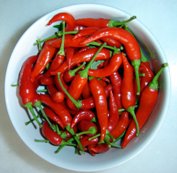
 Fresh isn’t always best when it comes to chilli, but I do prefer it. The flavors are more pronounced and the heat is [usually] more manageable.  Dry chillies have their place too particularly in winter when fresh are pricey and hard to come by.  In New Zealand you’re only likely to find a few varieties of fresh chilli in shops or markets.  Most are forms of capsicum annum [which also includes sweet capsicums/peppers]. Many more can be found in seed catalogues if these don’t cut the mustard and now is the time to be planting…

 Common chillies

 Cayenne. [Capsicum annum]

The long, red, supermarket chilli and a good work-horse variety.  Moderately hot, with that pleasing blend of sweetness and acridity, they are just as good cooked, raw or dried. I use and grow more of these than any other chilli.  

Jalapeno [capsicum annum]

Fleshy with a blister-streaked skin, this is a great chilli for eating raw or pickled. Yes they’re hot, but not menacingly so and they have a distinctive grassy flavor. Great with cheese.

Banana or Hungarian. [Capsicum annum]

Large and usually [with the odd bowel purging exception] quite mild. Good fried in olive oil and sprinkled with sea salt as anti-pasto.

Thai or birds-eye [Capsicum annum]

Very small and very hot. Good to add heat to dishes but tends to obliterate flavour. Tread carefully.

 
Less common ChilliesHabenero/Scotch bonnet. [Capsicum chinensis]

 Another species and another level of pain. This group have the distinction of including among their ranks, the worlds hottest chillies [in some cases thousands of times hotter than a cayenne], and even the tamest examples are frighteningly fierce. However, if you can handle the 3rd degree burns, they also deliver more flavour than any other chilli.  Members of this group have a complex and very more-ish, apricoty flavour and fragrance.  Way too hot for most but by far the most interesting chilli, taste-wise. I’m trialing a low-heat form in my garden this summer and am already fanaticizing about eating them sun- warmed and fresh off the bush.

 Rocotto/Perenial chilli/Gringo Killers. [Capsicum pubescens]

Large, fleshy and appallingly hot. These malevolent S.O.Bs belong to a different species again to any of the above and are best avoided by all but the chilli masochist. Most of the heat but none of the finesse of the previous.
 Now to apply your knowledge…

Chilli con Carne
That’s chilli and meat to us of the non parlo Espanola brigade.  This much abused dish has strayed from its perfectly respectable Tex/Mex roots into a pub-food standard that is often little more than baked beans and mince.  When made with a little care and respect it can be an economical, nourishing plateful of happiness. There’s lots of room for personal preference in this recipe.   Make it fiery hot or foppishly mild; it’s entirely up to you. The cocoa adds a truly Mexican dimension and extra depth of flavor, while the optional extra of smoked paprika imparts a distinctively southern-states feel.  I’ve fed this to fussy children and tame-tongued adults alike and have thus far received no complaints.


Ingredients

1 can tomatoes chopped

1 can kidneys beans, drained and rinsed [use dried beans if you can bothered. I can’t]

4-500 grams prime minced beef

1 onion, finely chopped

5+ cloves NZ garlic crushed

Fresh or dried chillies [preferably cayenne]

1-2 tablespoons ground cumin

1 teaspoon cocoa powder

2-3 tablespoons paprika

1- 2 teaspoons Smoked paprika [optional]

Lime or lemon juice

 Heat a heavy pan or wok over a moderate heat. Fry the onions in oil until translucent and lightly browned. Add the garlic and fry for a further minute or two. Raise the temperature and add the meat. Fry until browned and beefy-fragrant. Add the chilli to taste, add the cumin. Stir briefly and add the tomatoes and beans. Reduce heat to a low simmer and cook for 10-15 minutes until slightly  reduced. To prevent sticking add a little water if necessary.

Stir in cocoa and paprika, season and add citrus juice to taste.

Cook for a further 10 minutes, adjust seasoning and stir in smoked paprika if desired. Don’t add it earlier as the smoky flavour will be lost.

Serve with rice, and complete with fresh salsa [tomatoes, pineapple, guacamole etc], sour cream and a sprinkle of fresh coriander leaves. Soft tortilla fried in oil until crispy goes very nicely here too.

 Obviously there are millions of other ways with chilli, but this is reliable crowd pleaser with plenty of chilli flavour – thanks to the paprika,  and as much or as little heat as you can endure.

 
Finally, it seems like everyone has a chilli horror story [see my bathroom mishap above]. Care to share? Go on, consider it therapy!

Food For A Perfect Day…

Such a perfect day [I’m glad I spent it with food]
Virgil Evetts

 Last Friday was my annual salami day. This is a private culinary conceit I observe every year. I take the day off work [I get a perverse pleasure out of requesting annual leave for ‘Salami Day’] and have the house to myself.  It’s meaty, messy chaos, with blood, garlic, paprika and fat splattered far and wide. My best beloved, the queen of clean would drop a litter of kittens if she saw the kitchen in this state. It acquires a sort of abattoir chic. Suffice to say I had a great morning alone with 10 kilos of pork and my Kitchenaid

The sausages hang-around for about 8 weeks in my garage, slowing shrinking into tight little fingers of garlicky, fennely, porky bliss.

 So with the salami-to-be hanging, and a quick sun-nap later, my mind strayed to dinner.  Maybe it was the kneading of all that raw, hormone-rich pork, maybe it was the fragrant spring air or maybe it was just gluttony, but I was overtaken by the snap crackle and pop of seasonal ambition and quickly mapped out this Spring themed dinner.

 Entrée

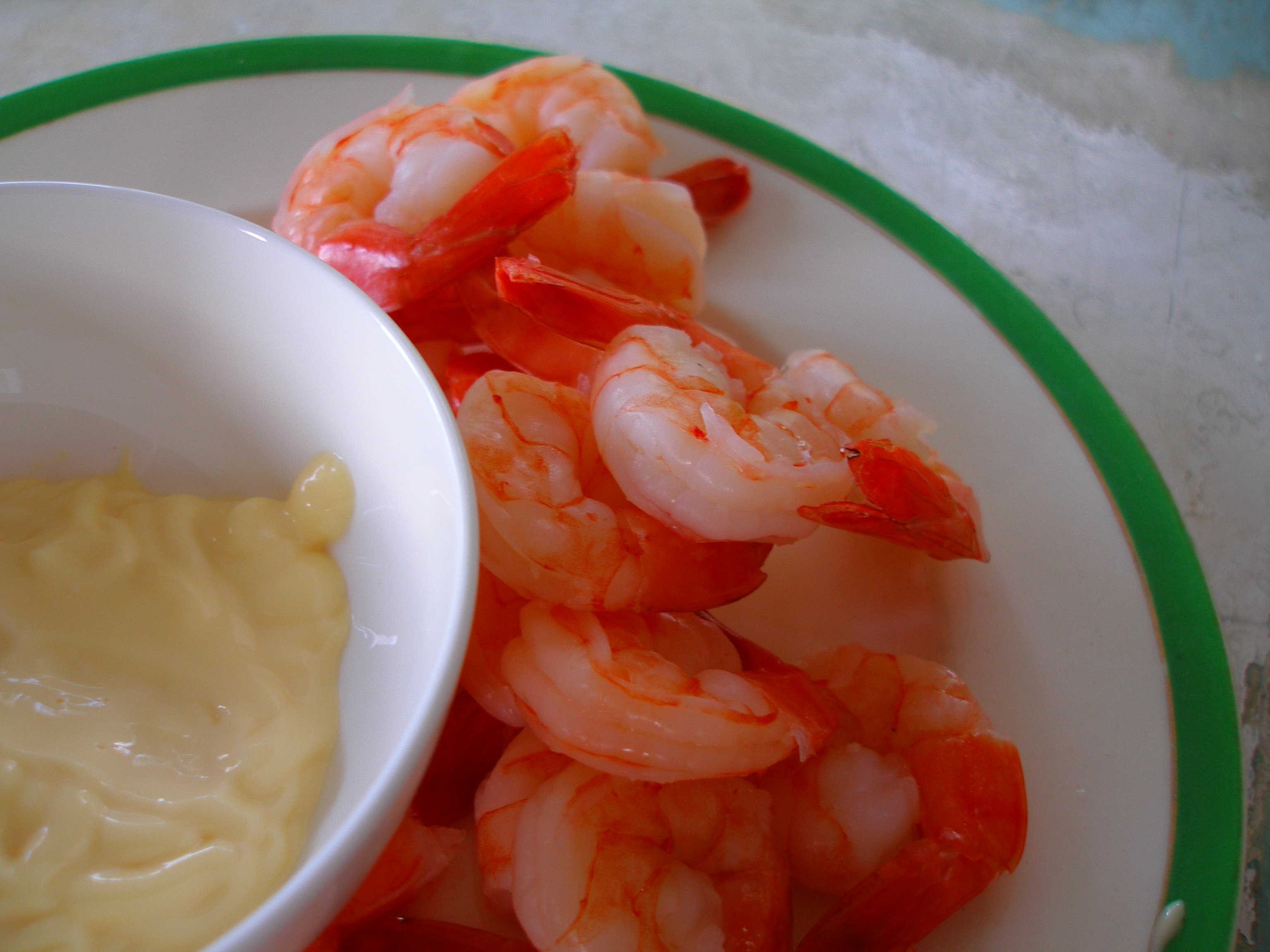
Boiled prawns and Japanese mayo

 Main

Asparagus risotto with wine moat

 Dessert

Home-made fresh ricotta with strawberry coulis

 Naturally this would be lubricated throughout with plenty of a cold, crisp wine and maybe capped off and/or preceded with a grappa or two.

 The Entrée

What is it about crustaceans and fat? They’re just a pre-ordained hook-up, don’t you think?  crayfish and garlic butter, potted [in butter] shrimps, prawns and [fatty] bacon, tempura soft shelled crab…

 I was pondering this very thought while my best beloved and I worked our way though a large plate of freshly boiled tiger prawns served with nothing more than a bowl of that mind-blowingly good Japanese mayonnaise. The firm texture and pure flavour of the prawns, unaffected by any of the usual abuse I hurl at them, and the creamy, fatty perfection that is Japanese mayo.  This has got to be just about the best commercial mayonnaise available [and this is something I normally get all judgemental about people buying]. I wouldn’t know where to begin improving on this stuff, and I like to think I can knock-off a pretty decent mayo when the mood takes me.

We washed this lot down with icy cold Cava, the cheap but nice Spanish bubbly.  By the way, boil the prawns, briefly, in well salted [as-in none of your namby-pamby salt modesty thank you very much] water.  Mayo from Japan, prawns from Thailand and wine from Spain. Oh dear…think of the food miles (actually don’t; it’s a nonsense science, and not worth sweating over).

 The Main

Asparagus.  As the season progresses we roll out all manner of treatments for this most noble [except for the whole pee thing] of vegetables; but our first taste of the season is always in the form of risotto.

 In the past I’ve been a serious risotto puritan; I was full of swagger and pomposity about the best rice, the best stock, the need for constant stirring. Well, as history has shown, puritanism is hard work and doesn’t exactly make one popular in the playground.  So I’ve learned to be a little less precious and to break a few rules. The greatest risotto sacrilege I commit [and this is a big one; they deport you for less in Northern Italy e.g. coming from Southern Italy] is to use basmati rice in all summer risotti.

 The reason for this is two fold – it produces a less stodgy risotto than any of those over-hyped Italian short grains, and I’m far more likely to have it in the pantry in the event of risotto emergencies, which are strangely common in my odd little life.

Call me a freak, but I think asparagus risotto should taste like asparagus, so why make it with chicken stock, which unsurprisingly tastes pretty avian? In my books [and I have a lot of them] vegetable stock is the only way to go here. Ideally, make your own with a bit of this and a bit of that from the garden and/or the fridge [but no celery leaves; too bitter].

Throw the sparrows-grass trimmings [is it just my mum who calls it that?] into the almost-finished stock and simmer for about 10-15. Any longer and the flavour gets lost in all that murky greenness.

 Apart from those few scandalous mods, I make my risotto in the usual fashion. I’ll spare you the tedium of an actual recipe here as a number of very good renditions can be found on this site.  I do however like to finish my risotti with a final flourish borrowed from the inimitable Elizabeth David. I pour about ¼ cup of white wine, preferably sauvignon blanc, over the plated risotto.  Initially I had my doubts about this carry-on, but after one mouthful I was totally sold. The wine accentuates all those herbaceous spring flavours and the acidity cuts smartly through the fat.

 Very young sauvignon blanc is the only wine to drink with this dish and spring is the only time to drink it.  It might be the most widely [and arguably over-] planted wine grape in New Zealand, but for most of the year I’m not a big fan. It can be such a one track wine. But give it to me freshly bottled and I’m more than partial.  For its first 6 months or so SB is full of young, green flavours; it’s super crisp and overflowing with gooseberry zing.  Spring in a bottle.  Sadly the annual arrival of SB on our shelves [around September] passes without so much as a bleep of hype. If the French can have their wretched Beaujolais day, in honour of the god-awful Beaujolais nouveau, why can’t we have Sauvignon day? At least SB starts off well.  Fancy starting a petition, anyone?

 Dessert

This dish has its origins in a disastrous attempt at making paneer, the tofu-esque curd cheese popular in Indian vegetarian cooking. Instead of a nice lump of squeaky-firm paneer, I ended up with a whey-weeping dollop of ricotta-like mush. After the usual raging and sulking that follows all my best kitchen screw-ups, I discovered that this abortive mess actually tasted rather good. Nice texture too.

 A tweak or two later and this has become one of our favourite desserts. It tastes purely and sweetly of milk.  The texture is velveteen-fine, cool and moist with a slightly acid whey.

We like it served chilled with a berry coulis.  It’s got a sparseness to it that shouldn’t really work, but trust me; it’s a beautiful thing.

In these day of soaring dairy prices  this isn’t the cheapest dessert you could lay-on for the Joneses, but it makes up for it in simplicity of execution and startling sophistication. In other words, it’s a doddle to make and goes down a treat.

 Here’s what you do; in a saucepan heat about 1 litre of full cream milk per person. Remove from heat just before boiling and add about ¼ cup lemon juice per litre of milk. The milk should curdle.  Stir and allow to cool. Pour into a sieve and allow to drain completely. This may take a couple of hours. Discard the whey.  You should end up with a nice, soft round of ‘ricotta’ that can be carefully inverted onto a plate.  Serve chilled with a berry coulis  and a mint leaf if you must.

 Now just tell me those aren’t the makings of a perfect day.

Sexy Food

10 things I ate about you
A short guide to the worlds sexiest food – Virgil Evetts

Can food be sexy? I think it can. I don’t mean in some in some icky, ‘9 ½ Weeks’ sort of way, nor the very dubious cult of aphrodisiacs, [which suggests that anything vaguely phallic will transform you into a Lothario of Warren Beatty proportions]. What I’m talking about are those foods that, for whatever elusive or overt properties, are just so damn sexy.

Think of the warm gush of sweet, liquefied fat when you crunch through the crackling of roast pork belly. Imagine those tiny explosions of lactic acid crystal as you bite down on a chunk of vintage Parmesan. Now, just try to tell me that’s not sexy.

So I’ve been slowly compiling a list of the most drop-dead hot, oughta-be-R-rated foods I know.

Now obviously, like all lists, this tells you more about the author’s predilections than anything else. There’s no science to this, I didn’t survey the nation. It’s just about me and the foods that make me swoon.

You might disagree with me completely; of course if you do, we can’t be friends anymore.

 #1 Foie gras de canard/oie

Ok, it’s reprehensible I know, what with the funnel-feeding of the birds and all, but this is undeniably hot stuff. Although the term technically just means duck (or even better, goose) liver, the intensive force-feeding transforms the liver into a stunningly rich, silky delight in a league very much of its own. Served ala parfait with toasted brioche and thick apple syrup, this is a treat so perfect that you may find the whole world briefly vanishes behind a wave of flavour and textural bliss. I kid you not; serious, ethics-challenging sexiness. Like having a crush on Hitler I guess.

 #2 Ganache

This miracle marriage of dark chocolate and cream is so often relegated to the centre of truffles [the chocolate kind] or the outside of cakes, but ganache can be so much more. The less cream you add, the thicker it becomes. You can roll it in cocoa, form it in moulds or just lick it from your fingers like a baby with the batter-bowl. To my mind this is just about the truest expression of chocolate; a perfect, sophisticated balance of bitter and sweet with a meltingly silky texture and a clean finish on the palate. This is a little piece of heaven we can all afford.

 #3 King Salmon

The Scots are always banging on about their precious Highland salmon. It’s the Queen’s favourite fish you know. You know what else? It’s not really very good. I suppose if you’d never eaten salmon before you might be fooled, but frankly this fish [A.K.A Atlantic salmon] just doesn’t rate next to our very own [well not really, its an introduced species.] King salmon. With its svelte smoothness, unmistakable fragrance and rich, fatty flavour, King salmon is the number one luxury fish of choice for many New Zealanders [although ironically it’s now cheaper than fresh snapper]. Sear it, smoke it hot or cold, eat it raw, bake it with cream or do as the Swedes do and rustle-up some gravlax; however you approach it, this fish is one hell of a culinary turn-on.

 #4 Prosciutto cruda & Jamón ibérico

These are some miraculous meats. They really are. Take the leg of a pig, add salt; give it some time and voila! You have a velveteen pleasure worth hundreds of dollars per kilo, with a complexity of flavour and texture that puts the best wines to shame. Of course it’s not really that easy. Along the way, the Spanish and Italians work some secret Latin mojo on these hams. A lot of picture-postcard propaganda about the sweet air of Tuscan meadows or diets of acorns is thrown about, but I suspect witchcraft. Nothing this seductive could be natural or Godly, but it’s totally worth an eternity of pitch forks in the bott-bott.

 #5 Duck

Dense, flavoursome meat. sweet, copious fat and shatteringly crispy skin. This is the bird that chicken should have been. I’ve been a fan all my life, and still go out of my way to find the best purveyor of Donald wherever I am. Often it’s my own kitchen, as good quality duck is steadily becoming an affordable meat. One of the many delights of Auckland’s large Asian population is that BBQ and roast duck is available far and wide. Chinese roast duck, to my mind, is the definitive way of partaking of le canard. Served on rice with just steamed bok-choy it’s an exercise in understated class. The food version of the little black dress, if you will.


#6 Tartufo Bianco – White Truffles

These ugly little fungoid lumps are easily the most overtly, indecently sexy items on my [or probably any] list. With a blush-inducing, musky fragrance that hits you like a dose of pheromones and totally subdues any resistance, this is food on-heat. I’ve only had fresh white truffles twice in my life, on both occasions simply shaved over fresh, buttered pasta. Sounds ho-hum, but remains my most haunting food memory. Truffles of either persuasion [white or black] cost stupid amounts of money, so are seriously special occasion items, but at least once in your life treat yourself. Then get thee to a convent.


#7 Parmigiano Reggiano- Parmesan

Forget the Renaissance; spare me your pyramids. The greatest feat of human kind is quite obviously the creation of this cheese. With nothing more than milk, mould and time, Medieval Italians created this cheese of cheeses. With its gorgeous unfolding bouquet, extravagantly complex flavour and crumbly crystalline texture, Parmigiano is a class act. Despite its fame as a cooking cheese, I like it best au natural -fresh off the block or with wild rocket [ruccula] and a splash of grassy young olive oil. It sure ain’t cheap down here in Kiwi-land, but a little goes a very long way. Ok that’s a total lie; it’s more than possible and totally bliss to wolf down a small fortune’s worth in one go.

 #8 Butter

A surprise choice perhaps, but only because we take it for granted. Butter is like the girl next-door. Familiar and homely, but once she moves away you realise you’re madly in love with her. We are very fortunate in New Zealand to have 100% grass fed cattle. This makes for vibrantly coloured, richly flavoured butter. Sure its’ something of a pariah in health-conscious circles, but really: a little bit of self control people! Used in moderation, like anything on the food axis of evil [animal fats, salt, sugar, etc etc] butter is fabulous stuff. We all know it’s many practical roles in the kitchen – frying, baking blah, blah ,blah. But is there anything finer than perfect New Zealand butter, brought up to room temperature and spread thickly on billowy fresh bread?

 #9 Mozzarella di bufala

Like a kiss from bobby-calf, Mozzarella di bufala is the Queen of stretched curd cheeses. Picture a blindingly white sphere, dewy with not-quite-sour, grassy whey and composed of layer upon layer of crepe-fine curd. This is a pure distillation of the very best milk, squeezed from strapping big water buffalos in Southern Italy. Sadly, the Italian mozzarella industry is in pretty poor health at present due to an ongoing dioxin scare in Southern Italian pastures. This appears to be a result of Mafia control of the waste management industry and Governmental corruption. Fortunately farmers in both Australia and New Zealand are building up commercial herds of water buffalos. Its early days though and prices are through the roof.

If you do get your hands on some ‘di bufalo [carcinogenic or otherwise] there is no other way to eat it than roughly torn with explosively ripe plum tomatoes, fresh basil and a careless splash of oleo.


#10 Pork belly

The most underrated part of the pig, but in my oh-so-humble opinion it offers some of the best eating of any meat. It’s spectacularly fatty stuff, but that’s kind of the point. You’ve heard it before: fat carries flavour [which is in rich, porky abundance here], keeps the meat moist, and helps to crisp the crackling. I can’t think about this stuff with out salivating; it’s everything pork should be – sweet, rich, succulent and moist. When treated kindly it turns out the best crackling you will ever experience. I say experience because taste alone just doesn’t cover it.

While the Chinese are the true masters of handling this cut, it’s pretty forgiving stuff if you follow a few simple rules. Prick the skin like crazy, pour boiling water over it, salt it and roast it gently on rack over a water bath. Enough to turn a Rabbi.

Well there you have it; 10 foods that float my boat. Do you have a list?

The Colonels Fried Chicken

Colonel Virgils Fried Chicken

So KFC got free-global advertising this week, with the apparently news-worthy revelation that the Colonels original hand written recipe for the secret pleasure of millions has been moved from its strong hold for the first time in decades during security upgrades at the multi-nats head office..

 A lot nonsense rumour and myth is spread [mostly by KFC themselves] about the ‘11 secret herbs and spices’ recipes, supposedly ‘invented’ by Colonel Sanders, The self-styled southern dandy’ whose curiously God-like image adorns buckets of the diabetes and obesity-courting white-meat the world over.

Well if he invented KFC, I invented schnitzel. That original recipe is about as complicated and mysterious as Nicky Watson [a walking flotation device of a ‘woman’ who married well, divorced even better and reportedly has the I.Q of a lemming. Made headline recently over the disappearance of her small dog. She posted ads across Auckland begging for the return of her ‘Chawaawaa’] and certainly existed before Sanders turned up on the scene. It’s a Southern standard in the States; in fact most things are popular deep-fried in those parts. Fried chicken has a long history in Jewish cooking too, where it’s often served very simply with pomegranate molasses as a dipping sauce. This is a truly sublime coupling. The sharpness of the molasses cuts across the fattiness of the chicken, cleaning your palate of all that sin and rounding out the flavours. Beautiful.

Now I’m not proud of this, but I must admit that I’ve eaten my fair share of genuine KFC, and I still go slightly weak at the knees when that unmistakable smell gets it tendrils into my brain. But however successfully it may posses me in the moment, I know that KFC use production line chickens who have lived brief, unhappy lives on a diet of god-knows what. Once dispatched and dismembered said chicken is coated in a number of things that aren’t so much secret as numerical and fried in ghastly KFC brand -super-fat.

However, with a few minor tweaks, it’s possible to produce an equivalent that outshines the so called Colonel’s bird on all levels. Yes. We have the technology. Well the common sence, good taste and respect for poultry anyway.

So now, at the risk of being picked off by a KFC hit-squad, I give you the ultimate culinary spoiler:


Fried Chicken: Colonel Virgil’s Unoriginal Recipe


1 cup flour

2 Tbs fine sea salt

1 Tbs finely ground black pepper

Free-range chicken pieces – skin-on and bone-in

Good quality, neutral tasting oil for deep frying- Canola, Sunflower or Grape-seed. NOT Olive

 I know, fiendishly brilliant, but that’s really all there is to it. My guess is that the actual KFC recipe also includes a good measure of MSG. You could add that if you wanted, but it only serves to heighten existing flavours. I leave it out as MSG seems to do funny things to my stomach. According to all research on the matter this can only be psychological. Go figure.

 Deep-frying is a scary business. I won’t go near it without an electric, thermostatically controlled deep-fryer, but I’m a wimp like that, it’s perfectly do-able on the stove top. You just need to be careful, ideally use a deep-frying thermometer and NEVER walk away from the pot. Whichever you have access to should be heated to about 180-190 Celsius. Any higher can be dangerous, but even on a stove top it’s easy to control the temperature, and once the chicken is added it won’t be a problem.

Mix together the dry ingredients in a plastic bag. Add the chicken pieces [fully-thawed] and shake vigorously.

 Add chicken pieces to the oil in batches. Overloading will cause it to rapidly cool, resulting in oil-stewed rather than fried chicken. Cooking time is variable, but at least 5-10 minutes is likely in a home set up. They should end up nice golden brown colour and obviously the juices should run clear when poked with a knife. Shake off any excess oil and rest on kitchen paper [the chicken, not you].

Serve with lemon wedges and plenty of pomegranate molasses. The smell of this chicken is totally intoxicating [although it does tend to linger] and you will find yourselves fighting over the fattiest, crispiest pieces.

In my experience this stuff goes down a treat with people of all ages and persuasions [except for spoil-sport vegos]


Now here’s a funny thing. As mentioned above, this recipe and technique is quite possibly based on an old Jewish recipe.

Now if we attribute to its most famous rendition to Colonel Sanders, we are left with a question. Exactly what was a fine old southern gent, a veritable off-duty clansman doing with a Jewish chicken recipe? Come to think of it, he couldn’t have looked more Anglo-Saxon if he tried – white hair, white [and frankly ridiculous] beard and white suit. Isn’t that whole ‘look at me; I’m a good-old-boy’ act a bit OTT? So was Colonel Sanders really a self-loathing, heritage-denying southern Jew? Now there’s a low-rent History Channel doco just waiting to be made!

Enjoy and don’t walk away from the stove!

Read more by Virgil

Swedish Meatballs with Virgil

Around the world in 80 Hejs – My ongoing world tour of Swedish fast foodjoints

Virgil Evetts

I’ve just returned from Thailand and Malaysia, both homes to a wealth of wonderful, exciting foods. So how is it that instead of nasi lemak or tom kah gai I’m writing about Swedish meatballs? Well, sit back while I spin you a tale of woe, gallantry and processed meat.

 My best beloved has a dangerous, obsessive fixation with those global purveyors of all that is smart and cheap, Ikea. This means that travel with her always involves a trip, or as is far more likely, numerous trips to the nearest branch. Of course, Ikea stores are never particularly near, meaning long taxi journeys to far-flung industrial estates or perilous train trips to the often scary [I’m Devonport born and bred, so am easily frightened] outer suburbs of big cities. The trip to the Rome branch was particularly harrowing. Highlights included being trapped in a tube station during a Gypsy knife-brawl and walking along an Autostrada on-ramp at night. The Autostrada lacks both footpaths and speed limits.

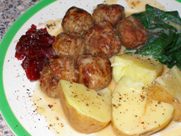
As you can see, I’m a kindly, indulgent partner, so it’s only fair that I get something in return. So I have one small condition. If I must endure another 2 hours in the land of flat packed furniture, I get to eat at the Ikea restaurant. More specifically eat meatballs or köttbullar with boiled potatoes, cream sauce and lingonberry jelly.

I know, it’s mass produced, additive-rich, ultra-processed, faux-food. But I find it all so irresistibly good.

For some time I kept this shameful fetish to myself. However, when I finally visited I Sweden last year I learned [to my endless delight] that the Ikea rendition of this very traditional dish is considered pretty much archetypal. I even met a family of Swedes who had never bought furniture from Ikea [too passé and mass-market , they were Architects you see] but ate dinner there every Friday night! ‘Better than my mother made’ said the father.

So finally it’s out in the open. I love Ikea meatballs, and Sweden is right behind me!

 Whenever I fall in love with a dish I immediately need to know how it’s made. Not only so I can replicate it at home, because while it’s nice to add another feather to ones cap, the best meals are often more about the time, place and company than flavour. For me, knowing how a dish is made helps me to appreciate and understand it properly, even if I never make it again. Having said that, I enjoy eating köttbullar anywhere and anytime, and have done so on most continents, thanks to the world-wide reach of the Ikea empire and now, my ability to replicate it or something very like it anyway.

It took a couple of years on and off to work out my köttbullar recipe. I did much reading, much cooking and much tasting before I felt like I’d come anywhere close to the Swedish original. I can guarantee that the recipe is reliable and very easy. I believe that it’s a pretty true and rather good rendition of this great, if somewhat humble national dish. You can decide if I’ve hit the mark.

In true Scandi-fashion, this is a dish of bold flavours and textures but it demonstrate a degree of restraint and discipline more akin to the Japanese culinary aesthetic [in terms of the sparseness, not the actual flavours] than anything you would find in Southern Europe. Furthermore, this its very much the sum total of its parts. The meatballs are very nice on their own, but only truly shine when brought together with the cream sauce, the potatoes, the lingonberry [or cranberry] jelly, and the wilted greens. It’s really one of those ‘don’t mess with the classics’ sort of things. Call me a purist if you will.

Although I’d rather not know what goes into the processed version of köttbullar [regardless of how good they may taste], traditionally the Swedes use a mix of veal or beef and pork. However you may feel about pork farming and swine-welfare, the meat is important here. It counters the dryness of the beef and helps to bind the mixture. The spices: nutmeg, allspice and white pepper are very traditional and much used in Northern Europe and give a lovely sweetness and fragrance to the meatballs.

The cream sauce is really just reduced, thickened beef stock with a little [or a lot of] cream added, but it’s awfully good. You may even find yourself wondering if you could get away with sculling it from the jug when nobody is looking. I can tell you its possible but requires a good diversion. You can’t cut-corners with the stock. It has to be home-made [ok, so there are one or two passable commercial brands, but none of them come in cubes!] and it has to be very good.

Lingonberry jelly appears on the table as an almost standard condiment in Sweden. It has a very similar taste to cranberry [a closely related plant], but it’s just a little tarter, with a more defined taste. In this dish, the sharpness contrasts nicely with the richness of the cream sauce and the sugar marries with the nutmeg and allspice in the meat. Lingonberries grow wild all over Scandinavia, and picking them is a popular summer pass-time . In New Zealand, you can get Lingonberry jelly in the odd speciality shop, but it may take some searching. Cranberry works just as well. The greens can either be spinach or silver beet, but should only be just cooked. The velvety texture and slight salty-bitterness is the last piece in the flavour puzzle really. You will notice this dish is not exactly in the Weight-Watchers mold of cooking. The meatballs and the sauce both include cream, and butter sneaks in on the act too. Spare me your substitutions; it’s just a bit of fat.

 Köttbullar [Swedish meatballs)


For the meatballs

 About 250 grams each of beef and pork mince
1 handful of fresh, finely ground wholemeal bread crumbs
1 egg
¼ cup cream
1 tsp ground nutmeg
1 tsp ground allspice
1 tsp ground white pepper
Salt

 For the cream sauce
1 small knob of butter and/[preferably]or cooking juices from the meatballs.
1-2 tbls flour
500 mls rich, preferably home-made beef stock. Absolutely NOT stock cubes.
½ cup + fresh cream

Preheat your oven to about 190-200 C.


To make the meatballs

Put all of the ingredients into a mixing bowl and… mix. The meat needs far more blending than you are probably used to with other meatballs. Ideally use an electric mixer or if you rely on peddle-power, get your hands in there and kneed it like bread dough that has offended you. If the mixture is too wet add more bread crumbs, if it’s too dry, add a little more cream. You should end up with a completely smooth, homogenised, pink paste. It should feel light, airy and only slightly sticky. I can’t stress enough, the mixing is really important.

A step that otherwise very clever chefs often overlook with meatballs, patties and sausages, is that you must always, cook a small test piece in a hot pan. Never trust a recipe to the letter. Always use your senses.

Once the seasoning is to your liking, wet your hands and start forming the paste into small balls. I prefer them about the size of a ping-pong ball, but it’s up you.

Arrange in a single layer in a well oiled, heavy duty oven dish. I find a cast-iron skillet works well. Cook for about 30-40 minutes, turning occasionally until well browned.


You’re on your own here

Meanwhile you should be attending to the potatoes and greens. I’m not Delia Smith; you can figure that part out for yourself. However, I believe in skins-on and well salted cooking water when it comes to potatoes.

To make the sauce

When the meatballs are cooked, drain off any juices [AKA, sweet, delicious pork fat] into a saucepan, add a small knob of butter and bring to a happy sizzle. Add the flour and briskly stir in. Slowly start adding the stock. Use a whisk at this point to avoid lumps. When all the stock has been added and the mixture has started to thicken, adjust the seasoning and whisk in the cream. Remove from heat

To serve, portion out the various parts however you like, but allow plenty of sauce and jelly for everyone, but especially for yourself.

Serve with
Floury potatoes- I’m mad on agria, but use whatever floats your boat.

Silverbeet or spinach. I prefer the former in this case as it has an earthier taste better suited to the other flavours.

Lingonberry jelly/sauce on the off-chance you can get it, or cranberry.

Of Pasta and Pasta Sauce

Of Prostitutes and Pasta sauce – Virgil Evetts 

 You people make me sick! Well some of you do anyway. Ok, so maybe not sick, but slightly seedy with disappointment at the very least.

 I’m referring to those amongst you who park your trolleys in the ever-expanding pre-made pasta sauce section of the supermarket and after much deliberation actually BUY the stuff [!!!]. This is almost as unforgivable a sin as buying pre-made vinaigrette [which on reflection is less sin than proof of patent stupidity]. Yes, I’m on a bit of self-important tirade here, but A/ what else is food writing really? And B/ this is an issue that really gets my goat.

 Sure, those jars of red stuff masquerading as authentic Italian pasta sauces contain all sorts of appealing ingredients, and are, by and large, free of anything very malignant in the way of additives. But, and this is a very big but, THEY ALL TASTE THE SAME. Tomatoey and oniony, with the whiff of the pressure-cooker about them and a mystery flavor note that is probably everybody’s favourite preservative- ascorbic acid [Vitamin C]. Just because Vitamin C is good for us doesn’t mean it tastes nice or has any business loitering about in a pasta sauce.

 In Italy, you will never find anything resembling Dolmio [beware of food sold by puppets] style sauces. These products are really more like a sort of inferior ratatouille. Maybe you like that, I don’t know; but lets you and I never speak of them again.

 Ok, so if I’m going to crucify you for your lazy, freshness-seal popping ways, it’s only fair that I offer you an alternative.

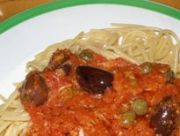
 Spaghetti alla Puttanesca is a fixture on most Italian restaurant menus here and abroad, but frustratingly its one of those things that, despite being such a doddle to throw together, so often arrives watery and underwhelming. My theory about this is that the simpler dishes are farmed out to the kitchen hands, who don’t know what they are doing and don’t much care. Trouble is, the simpler a dish is, the easier it is to mess up.

The origins of this sauce are rather murky. Puttana is a rather unflattering Italian word for a prostitute. So literally translated Spaghetti alla Puttanesca means whores’ spaghetti. One story says that it was favored by overworked Napolese prostitutes because it could be thrown together in a hurry i.e. between sailors [ not literally]. Other stories suggest it was served to the clients of prostitutes while they waited in line. In fact the only verifiable detail is that it was first made in Napoli during the 1950s or 60s.

Disappointingly [because I quite like these stories] the consensus of opinion among Italian food scholars is that Spaghetti alla Puttanesca probably just means tarted-up spaghetti- referring to the chilli, olives and capers. Undaunted, my Best Beloved’s teenage brother still refers to it as ‘Sluts’ Spaghetti‘. Nice.

 Origins and salacious stories aside, this is great dish. Spicy, rich and redolent with garlic. And, as the working girls [and boys I suppose] of the South may or may not have found, it can be thrown together in a jiffy from a few common pantry items.

 Spaghetti alla Puttanesca

I find published recipes are very timid about garlic. Live a little. This is meant to be gutsy food.

As every chilli is different you will need to make your own mind up about quantities. The sauce should be spicy but not incendiary, so tread carefully- especially with dry chilies which can be sneaky little bastards.

I’m not a great fan of anchovies on their own, but they are essential here, melted into the oil as part of a sort of Southern-style soffritto with garlic and chilli. The fillets lose all form and fishiness but add a certain depth of flavor to the sauce, not unlike the way fish sauce works in Thai food and asafetida works in some Indian dishes.

You will need:

2 cans Italian tomatoes
6-8 cloves of New Zealand garlic, [don’t get me started on the evil that is Chinese garlic]
Fresh or dried chilies [NOT Habenero]
3 or 4 anchovy fillets
black olives [preferably Kalamata or similar]
capers [if using salted capers be sure to soak them first]
extra virgin olive oil
salt and pepper
dried spaghetti

In a mortar and pestle pound together the garlic and chili. Heat about ¼ cup of olive oil in a heavy pan or wok. Add the garlic, chili and anchovies. Reduce heat and stir until garlic is translucent and anchovies have mostly dissolved. Do not allow garlic to burn or crisp. The bitterness will taint the whole dish

Increase heat again and add the tomatoes, one can at a time. When simmering, use a potato masher to pulp the tomatoes. Reduce heat and leave to simmer, uncovered for about 15-20 minutes. Stir occasionally and do not allow sauce to stick or burn.

By now the sauce will have thickened, darkened in colour and will smell rich and meaty.

Add about 6 olives and a teaspoon of capers per person, stir through and adjust the seasoning by taste. Remember that the olives and anchovies are quite salty so don’t over do it.

To each plate of cooked pasta ladle about ¼ to ½ cup of sauce. Less really is more with this sauce; it’s potent stuff and best savored in moderation.

Finish with a few shavings of Parmigiano or Grana Padano. Bliss.

I’ll leave you with a piece of sage advice.
If your best beloved ever asks, “If you had to choose between me or a wheel of Parmesan which would it be?” don’t consider the question for several minutes before saying ‘the cheese’. Dinner was a strained affair that night.

Black Pudding – It’s A Bloody Pleasure!

It’s A Bloody Pleasure!   Virgil Evetts

We’re fickle, delusional creatures us humans. We like to tell ourselves that we’re risk takers, adventurers, masters of all we survey. But you only have to look at how safely most of us eat to know that’s just not true.
Ultimately, no mater how articulate we are in the kitchen; our eating habits are led by our upbringing, our preconceptions and sorry, – our ignorance. We deny ourselves so many exciting new flavours and textures, because we don’t like how it smells, how it looks or what it’s made from. Partly that’s our instincts keeping us alive, but its mostly just narrow-mindedness.

Take durian for example, a ferociously spiky, indescribably pungent fruit popular throughout South East Asia. Its understandable that you will probably recoil from durian initially, but if you’re awfully brave and just bit grown-up about it, if you force yourself beyond that almost tangible stink, you’ll find something so disarmingly complex that unless told otherwise you’d assume it was crafted by a prodigiously talented [and slightly unhinged] chef. That’s not to say you will actually like it. But how would you know if you don’t at least try?
This is just one example of the many adventures we deny ourselves by skulking in our boring little comfort zones.

Now to be fair, durian is pretty extreme food. I like it, but only in small doses. A more accessible food that is often feared and reviled but is somewhat closer to my heart is black pudding. It’s one of the great gastronomical dividers.
A lot of people of a certain age will salivate at the mere mention of it, just about everyone else will be appalled by the very thought of the stuff, despite never having tried it.
I’m a bit of an anomaly myself, as I’m relatively young and adore black pudding. As a child I ate slices of it straight from the fridge the way other kids ate luncheon sausage. Once again though, this is probably not the best initiation for the newbie to a slightly out-there food.
Yes, black pudding really is made from blood. A lot of blood. But is that really so terrible?
We [most of us] happily eat the muscles of animals, their organs, fill their intestines with more of the above and eat that too, make desserts from their hooves and make cheese with their digestive secretions. So what’s the difference?
Although slight variations exist all over Europe and parts of Asia, blood sausages, black pudding, budin noir and so on are all essentially the same thing. Animal blood, usually beef or pig is mixed with ground meat of the same and various cereals, seasoned and stuffed into sausage casings.
The raw sausage is then cooked in boiling water, which causes the blood to congeal [not a food-friendly word, I know], thus setting the sausage.
Once cooled, black pudding is usually sliced and sautéed in butter or dripping. So that’s provenance and process laid bare but obviously you’ll want to know what you’re getting yourself into taste-wise too.

Probably not what you expect.
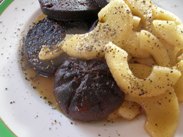
Black pudding has a very mild flavour and it doesn’t have any of the metallic quality you might expect from blood. It’s certainly meaty, slightly sweet and with a distinctly fudgy texture, which crisps and caramelise quickly in the pan. It’s an uncomplicated, rather comforting food. I particularly enjoy thick slices sautéed in butter with apples, a good slug of cider or white wine and something like ciabata to mop up the juices.
In much of Britain, back pudding is eaten at breakfast. I don’t really do breakfast myself, so when I have black pudding it tends to be for dinner or a snack.

Black Pudding for beginners
If you’re already a fan, you’ve probably had something like this before. It’s nothing new, just a gentle, crowd pleaser really. And if you’re a black pudding virgin [so to speak], it won’t be nearly as bad as you think. You might even like it, and if you don’t, well at least you’ve tried. Not a bad epitaph actually. At least he tried.
What goes in:
Black pudding
Crisp apple- peeled, cored and sliced
Cider or white wine
Butter
Bread- ciabatta or similar

What you do:
Slice the black pudding thickly. Finger thickness is a good guide.
Melt the butter in a medium sized pan on a medium-high heat. When sizzling, add the apple. Carefully brown, but don’t cook. Remove the apples from the pan and set aside Add the black pudding. Brown on both sides. This can a bit tricky to gage because of the colour of the sausage, but you’ll get the hang of it.. Remove the black pudding from the pan and set aside with the apples. Pour a good slug of cider or wine into the pan and swirl it around. Reduce slightly, season and briefly return the apples and pudding to the pan. Serve immediately and devour with bread and gusto.

Barley Risotto Recipe

Reluctant Barley Risotto – Virgil Evetts

I’m a bit slow off the mark when it comes to fad foods.  Every year a clutch of new gimmick ingredients and dishes spread through menus and magazines [beetroot and goat-cheese tart anyone?] like some sort of middleclass virus and I usually avoid them with a steely determination.

I’m quite in awe of true innovation in cooking, but, so often the next big thing is just an ironic reworking of a classic [celeriac carpaccio] or the product of a chef’s monstrous ego [the entire molecular gastronomy movement]. So perhaps unsurprisingly, I have ignored Pearl Barley Risotto in all its oh-so-clever forms for several years. Now I like a good risotto, its one my favourite comfort foods, and I like pearl barley too, in hearty, nostalgic winter soups but the idea of bringing method and ingredient together has never sat well with me.

I was wrong.

My mother has been singing the praises of barley lately. It features heavily in the soups and stews she seems to subsist on over winter, so I decided to pick up a packet and finally tackle my hybrid-risotto cringe.

I didn’t bother with a specific barley risotto recipe, assuming the usual method [sauté-stock-wine-stock-stock-butter-cheese…] would translate. For the most part, it did, the only differences were that barley takes quite a bit longer to cook than Arborio rice and it doesn’t require much stirring at all. That last point gets a very big tick from me, as the constant stirring of risotti can be very tedious. I was able to cover the pot [another departure from the norm] and leave it to its own devices for 10 minutes or so at a time. As usual I finished the risotto with a handful of grated Grana Padano and a spoonful of butter.


I was more than a little surprised by how very good it was. The barley has a more interesting mouth-feel than most Italian rice, the grains holding their form well, bursting with an almost audible ‘pop’ when you bite down.  Although mild in flavour, barley has a slight sweetness and nuttiness compared to the somewhat chalky Arborio.

The grains also seem less cloyingly starchy than rice, making it easier to maintain that slightly soupy quality that defines a good risotto.

All in all, I liked this dish very much. My best beloved, who has never been much moved by risotto, was very complimentary and even went so far as to say ‘who needs Arborio’?  

While I’m not quite ready to reject rice altogether in risotto [for grammatical reasons as much as anything else], I am certainly sold on this most humble of grains and intrigued by its potential.


Reluctant Barley Risotto

As with any risotto, there’s no point going forward without a good stock. So while there are plenty of acceptable options available in various cartons and pouches at the supermarket, I find it’s cheaper and more rewarding to buy a hot chicken ¼ and make my own. It fly’s in the face of my usual free-range only rule but realistically one can only ever be so true to ones ethics…


What goes in it

1litre good quality hot chicken stock
1 cup white wine
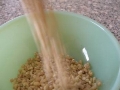
1 cup pearl barley
1 onion, finely chopped
butter
olive oil
Parmigiano or Grana Padano
salt and white pepper

 What you doHeat about a tablespoon of butter and a splash of oil in medium-sized, heavy-bottomed pot. Add the onion and reduce heat. Allow the onion to brown. Despite what a lot people will tell you, this takes at least 10-15 minutes. Don’t try to rush it or you will burn the onion and ruin the dish.


Add the barley and stir until well coated in butter.  Add about 1/3 of the stock, stir again and cover. Keep at a medium heat and leave for about 5 minutes or so. Keep adding the stock as it’s absorbed and keep testing the barley. At some point add the wine-it doesn’t  matter when. This risotto may take 40 minutes plus to cook- so be patient.  When it’s nearly done, remove the lid and turn up the heat. It will need more stirring now. You may find you run out of stock before the grains are cooked. Don’t worry, just add a little water or more wine. When you are quite happy with the consistency add the butter and cheese, stir and adjust the seasoning. Cover and allow to stand for 5 minutes or so. The finished risotto should be slightly soupy- in other words it shouldn’t sit on the plate like a mound of mashed potato.  You may notice I haven’t added saffron. This is a personal taste thing, I wanted to taste the barley and the stock above all else. If you must have your saffron, be my guest…

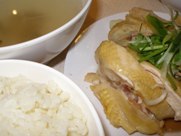
Hainanese Chicken Rice

Hainanese Chicken Rice with thanks to Keanu Reeves
Virgil Evetts
 
So it’s not exactly high-art, but The Matrix isn’t a bad film as far as disposable fluff goes. At the very least its a fun couple of hours, crammed full of eye-popping special effects and remarkably wooden acting from the remarkably wooden Keanu Reeves. The sequels stand as two of the worst films ever made.

Weirdly [although maybe not if you consider my food-centric world view], the one scene from The Matrix that always returns to me involves a conversation between two characters about the flavour of chicken. It’s revealed that the machines who have enslaved humanity and trapped us in a virtual facsimile of the world, couldn’t find any detailed description of the taste of chicken in human memory, only that most unfamiliar foods are described as ‘like chicken’.
The result was that inside the matrix EVERYTHING tasted like chicken.

I can’t help thinking that, should the machines eventually take over [ my MP3 player is well on the way] and defy all logic, common sense and efficiency in deciding to use us as an energy source by plugging us all into a virtual version of Sydney in the late 90’s, then chances are, we will indeed be stuck with the amorphous taste of ‘chicken’ for all time.

Because who can actually describe the flavour of chicken? And why do we describe so many other foods – frog’s legs, crocodile, bats, babies etc, – as tasting like chicken?

I think it has a lot to do with the quality of the chicken we eat. Until recently one was hard-pressed to find a decent bird in New Zealand [so to speak]. As, a result we have tended to use chicken as a vehicle for other flavours, rather than the star player. Whatever flabby flavour Henny-Penny had was lost under viscous sauces and streaky-bacon sarcophagi. Things have improved. Good quality chicken is now available in most supermarkets and is relatively well priced. The trouble is, most of us haven’t adjusted our thinking. We still use chicken as winged white bread to mop-up our gravy.

Now, I’ve eaten a lot of chicken, I’ve cooked a lot of chicken and I’ve travelled a fair bit to places where they do very clever things with chicken, and I think I can finally reveal, by way of a simple recipe , exactly what chicken tastes like.

Chicken Rice. Such a boring name really, but at least its succinct. Here in New Zealand, it probably evokes memories of horrid instant risotto products, but in Singapore or Malaysia, this name will lead you to a dish revered by both countries to an almost religious degree. Fans travel great distances and wait in epic queues to get the best renditions, and experts endlessly debate which ingredients are traditional and exactly how and when one should eat it. These politics and protocols don’t really interest me. Chicken rice is, very simply, my favourite dish, night or day. So far.

Known variously as Chicken Rice, Hainan chicken rice, Hunyu pinyin, Khao mun gai and Jyutping, this dish can be found all over South East Asia, but it’s earned it’s most devoted following in Malaysia and Singapore. Although a dish with its roots in the traditions of settlers from Hainan island, in China’s tropical south, the dish has evolved into something that is more of a hybrid of Hainanese, Cantonese and Malay techniques. The version found in Hainan today is probably more influenced by its Singaporean/Malay counterpart than vice versa.
A most unpretentious dish, Chicken rice is nothing more and nothing less than chicken, poached in a master stock [wait on, I’ll explain], thinly sliced and served with rice [cooked in more of the same], various condiments and a bowl of broth. It sounds kind of dull in print, but in reality, its like a distillation of all that is chickeny. The subtle use of spices, such as star anise, ginger and 5-spice, complement and lift the warm, clean flavor of the meat rather than drowning it. This is wholly satisfying stuff. Light yet filling and it leaves you feeling nourished and happy.

 The use of Master stocks is an ancient Chinese practise. The stock in question is often decades or even allegedly centuries old, permanently kept on the simmer, with more water and bones added as required. This results in a meaty elixir of incredible complexity, rivaling and sometimes surpassing, the oldest and finest aceto balsamico. All the best chicken rice stalls in Singapore treat their stock with great care and respect. Although variable in style and quality, the Chicken rice of the sweltering city-state is all the better for its molly-coddled stocks. Obviously, genuine vintage superior stock is out of the realms of possibility and safe kitchen hygiene practices for most of us, but I have worked out a pretty passable [I think] substitute.

 My Chicken Rice recipe is entirely reverse-engineered from the very best examples I’ve eaten in both Singapore and Malaysia. It’s a recipe that, once familiar is far better made by feel than exact quantities, and you will notice that I’m deliberately vague in places below. Traditionally, whole chickens are used. I don’t find this particularly practical, nor do I really enjoy dealing with all the bones, so I use boned, free range, corn-fed, skin-on, breast. Although an often boring, dry part of the bird, it works very well here.

Hainanese Chicken rice
You will need:
1 Free-range corn-fed chicken breast per person
For the ‘Superior’ Stock
1-2 litres of very good, preferably home-made chicken stock
1 onion
2 or 3 celery sticks. No leaves attached
Crushed fresh ginger -1-3 tbs
Star anise 5-10 stars
Five-spice powder 1-2 tsp
Whole pepper corns
Sesame oil- a good slug
Soy sauce- to taste
½ cup long-grain rice per person. I prefer Jasmine.


For the sauces
Sweet chili sauce and/or Indonesian chili sauce
Crushed fresh ginger
Light Soy sauce
Rice vinegar or very mild white wine vinegar
Sesame oil
Superior stock
Fish sauce
Brown Sugar [optional]


Bring the stock to the boil, add the onion, celery and dry spices. Cover and simmer for 1-2 hours. Add the ginger, sesame oil and season to taste with the soy sauce. Ginger and sesame oil both become bitter when over cooked and only an idiot would season (ie add salt or in this case soy suace) a stock before it’s done
Bring to the boil uncovered for about 5 minutes. Reduce to a low simmer.
Cook the rice in a separate pot. Use 1.5 cups of strained stock per cup of rice. Cover, bring to boil and reduce to a medium simmer. Do not wash the rice, do not stir the rice, and do not lift the lid. It will be perfectly cooked in about 10-15 minutes. Try to learn how to cook rice by sound- if its done it will quietly hiss. If it’s sizzling you’ve gone a bit far but all is not lost and if it’s crackling call the fire brigade.
Set aside [covered] when done. Cooked rice will remain hot for hours if covered.
Bring the stock back to the boil. Add the chicken breast. Cover and bring to a decent boil. Cook for 15-20 minutes.
Remove the breasts from the stock and plunge into a bowl of cold water [room temperature is fine] this will cause the flesh to quickly tighten, halting the cooking process and improving the texture dramatically. Remove from the water after about 1-2 minutes. Pat- dry and allow them to rest for about 10 minutes. I know this all sounds a bit fussy, but it’s really no trouble in practise.
Usually 2-3 dipping sauces are offered. Most importantly, one salty and soy-based, and one fiery and chilli-based.
The chili sauce particularly is taken very seriously by aficionados. Recipes are jealously guarded and are passed down from parent to child. So obviously, my version is only a best guess.
In a small ramekin or condiment bowl mix together 1-3 Tbs of sweet and/or Indonesian chili sauce, about 1 tsp crushed ginger, a few drops of light soy sauce and about ¼ cup of strained stock. Taste [carefully, it can pack a hefty punch]. Add more of whatever you think it needs.
In another small ramekin, condiment bowl (or whatever else you have in the way of tiny receptacles) mix about ¼ cup light soy sauce, 1 Tbs sesame oil, a little brown sugar and a splash of fish sauce.
Once again, adjust as you see fit and omit the fish sauce if you really must. A sauce is a very personal thing, I know.
To each plate add a generous mound of rice. Slice the chicken thinly, across the grain and arrange neatly on the plates, along with some sliced cucumber. Sprinkle a little chopped fresh coriander and spring onion over the chicken.

Alternatively, you can serve the chicken on a communal platter and allow people to help themselves.
Serve a small bowl of the [strained][ stock for each person. A few of the better bits of celery or onion from the stock and some fresh coriander leaves are always welcome too

There are various [and often rather anal] theories about how this dish should be eaten, but basically all agree that you should try to get a bit of everything- chicken, rice, sauces and cucumber in each mouth full. The broth is used as both a chaser and to moisten the rice as you go.

However, it’s your meal so eat it however you like, just promise me you won’t set your table with chop-sticks [unless you are Chinese]. Even the thought of it makes me cringe.

Don’t make this dish if you want big, brassy flavors. It’s not a curry, its not sweet and sour pork. Do make this dish if you want to taste chicken.