September – end

Hi there,

This week we have decided to take a step back to traditional baking with a special feature on  making the perfect sponge cake with Sally Cameron.   While Sally’s article is extremely comprehensive if you do have questions then please don’t hesitate to post them by scrolling to the bottom of the feature (yes I know it is a long way!).

Our win pages are continually being updated with new prizes so do keep a look out for exciting prize draw opportunities.

This week NW supermarkets are celebrating their wine awards and have all the recommendations you need to find the perfect drop at an affordable price.

While our facebook numbers are growing we really would like them to grow some more – if you are a facebook member then it would be great if you would follow us at Foodloversnz.  We post most days so you will have lots of recipe suggestions coming your way.

Happy Cooking!

Helen

Do You Practice Safe Cooking?

Irene Field


This topic of conversation came up recently with friends. They were staying overnight at our humble abode, and needless to say dinner was required.  I happened to mention the meal that I enjoyed when they last cooked, and was advised it was the only time it had been attempted and hadn’t been attempted again. Yet it was a beautiful Pork fillet, cooked to perfection.

 I then confessed that when I have guests I stick to the tried and true. Boring – yes.  At least I can relax, safe in the knowledge that my meal is edible. My friend advised that he is the exact opposite. He sticks to the tried and true for everyday meals, but when cooking for guests, the opposite applies. The recipe books come out and with a flourish and a flick of an apron and a whisk of an egg, wooden spoon or what have you, a new culinary dish is attempted.

 I really have to try and dip my toes into unknown waters where guests are concerned. If it is just us, I have no qualms and will devise concoctions of my own. Leading my dear husband to ask, is this an Irene recipe? If it is, can you please save it and remember what you did, so we can have it again.

 Possibly my reluctance to test a new recipe with guests harkens back to my young, flatting days (ie last month. OK I confess a couple of decades ago!). I was in a new country and attempting to make new friends. The dinner invitation went out to acquaintances. We sat down with our new friends to feast on the roast vegetables, the obligatory greens, and Corned Brisket – which I had roasted! Ha, can you imagine the chew fest that evolved. How was I to know that nice looking piece of beef had to be boiled? Fortunately we were flatting in the inner city. KFC made people salivate and they were conveniently located across the road – to where my partner was promptly dispensed to purchase some edible chicken. The embarrassment of that may have unknowingly scarred me for life, and hence my reluctance to treat guests with an untried recipe.

 Although not only us culinary scaredy-cats get it wrong. I happened to spy a recipe for a Risotto in a current popular woman’s magazine. The recipe calls for 750g of rice – to serve four people. Now I may be bottle blonde and I am no Nigella in the kitchen. Even I know that raw rice once cooked, triples in size. Imagine feeding dinner guests 2.25kgs of rice. Divide that by four, and you would require platters and not plates for the servings.

 It then occurred to me. Imagine if I attempted that recipe back in my young, innocent days.  

 Maybe it is safer to stick to the tried and true? What do you do when cooking for guests at home, and I am not talking BBQs or finger food here. I mean a sit down meal.  Will you attempt  a new recipe or play it safe?

 In case you were wondering. For that recent meal with our overnight guests, I decided to stick with an Italian theme. My lasagna, which I am a dab hand at. A green salad. Tiramisu (authentic recipe from scratch given to me by a lovely Italian friend) for dessert, washed down with Chianti. Background music provided by a mix of Dean Martin and Pavarotti for added intensity.

Easy Profiteroles

Although I have spent most of the last 20 years cooking, there are some things that have always been in my too hard basket and I have gently side stepped around making them.
Sponge cakes are one and profiteroles another – there will be plenty more but these are the two that first spring to mind.
Known for their trickiness and ability to be temperamental I have left them to those who know better.

Therefore it was with some trepidation that I took on a job to create a profiterole tower for a client that not only tasted good but also looked fabulous!

What to do….

After an inordinate amount of googling I then happened to  mention my issue to Laurel Watson of Petal Cupcake fame, and as luck would happen I asked just the right person!

Laurel has a wonderful  easy recipe for profiteroles that I think are foolproof – my first batch came out looking like something from a cake shop and they just keep getting better.

Melting butter in water is the first step and then once the flour is dumped into the  butter mixture it is just a matter of mixing (and mixing) over a low heat until a film of floury mixture appears across the bottom of the pan and the mixture starts to come together into a ball.  The mixture is then left to cool.
Then comes the even easier part – the mixture is placed in a food processor (it does need to be a decent sized bowl and a food processor with a decent amount of energy) and with the motor running eggs are dropped in, one at a time and spaced out so that the last egg is well incorporated before the next one goes in.

Once the mixture is made the rest is a doddle – simply spoon rounded circles onto a tray lined with a little baking paper and flicked with cold water (this creates steam during cooking), and then baked.
Once they come out of the oven, Sally Cameron suggests making a small slit with a sharp knife and returning them to the oven for a few minutes to ensure they are completely dried out.
They should feel light for their size.

I have now made literally hundreds and wonder what on earth I was ever afraid of.

Here is the recipe for completely easy profiteroles that anyone can make.

I find that choux pastry is best on the day of making but Sally insists that they can be frozen.

And my profiterole tower – gorgeous!


September

Hi there,

As a little support and thought to the teams competiting in the RWC we have been discussing recipes from the specific nations involved on the Kitchen and Garden Show, Radio Live.
Last week was Irish and we had a selection of lovely sounding recipes arriving in.  One which sounded positively delicious is a Guinness Chocolate Cake that was originally in St Patricks Cathedral cookbook, Dublin (published 1991).  I have made the cake and it is seriously good and decadent!  If you don’t want to drink the remaining Guinness then you could always add it to a beef stew.
With France playing this weekend there are sure to be a few more recipes to share!  Think I might make a cassoulet – a dish that is easily extended should numbers increase.

The best of NZ food is being showcased at the Cloud – Queens Wharf, Auckland.   I particularly liked the beef braised beef pie with kumara mash and macadamia topping.  Grahame Dawson has graciously shared this recipe.

Over the next few weeks we will have some exciting new features for you and some spot prizes around foodlovers forums and blogs.

Happy Cooking!

Helen

Why some recipes use baking powder and others use baking soda.

Helen Jackson

I often get asked when and why we use baking soda instead of baking powder in a recipe so here is a vey brief blog – open to discussion – on this.

Baking soda
or bicarbonate of soda is an alkaline that is  added to baking mixtures to balance out acid ingredients like yoghurt, buttermilk, sour cream, fruit, cocoa and vinegar.  Baking soda reacts instantly when moistened so it is important to get the mixture into the oven quickly.  The bubbles formed help to leaven and lighten baking.  Baking soda is generally best dissolved in milk or yoghurt prior to adding to the mixture and if adding as a dry ingredient make sure that you combine it with flour etc… and sift it into the mixture to ensure it is evenly dispersed.  Modern baking soda is finer than it used to be so modern recipes will often add it with dry ingredients and older recipes will ask for it to be dissolved first.

Recipes such as Gingerbread and banana cake predominately use baking soda, because they have added acid substances like bananas, brown sugars, golden syrup, and sometimes buttermilk or yoghurt. The baking soda, looks to neutralise these acids and make the cake more palatable.  You will also notice that the baking soda in banana cake or loaf reacts with the banana to give it a flecked deeper colour whereas if you use baking powder you will get a much paler cake.
Often chocolate cake will have baking soda as cocoa is acidic – Dutch processed cocoa however is alkaline and doesn’t react to baking soda.

 Baking powder is a mixture of baking soda and an acid such as Tartaric acid or what cooks call cream of tarter. When the two of these substances are combined and given heat like in a cooking process, the acid and alkali react together and create gas (carbon dioxide) which creates bubbles in the mixture and therefore create aeration and expansion which will lighten cakes and muffins. The general rule is mixing 1 cup of flour with 1 teaspoon of baking powder to get the desired effect.
Most baking powder used now is double acting which means it reacts to moisture and also to heat – therefore you will have some reaction when the batter is mixed and another when the batter is cooked.  Therefore you can wait for up to about 20 minutes before baking without impacting on the end result.
Too much baking powder will cause a bitter after taste – sometimes you will notice this with scones as they can be high in baking powder.  It can also cause cakes to rise quickly and then collapse.
When making pikelets, recipes will often have baking soda and cream of tarter as opposed to baking powder.  You can use baking powder but many proficient pikelet makers say that you get better results by adding soda and cream of tarter.

Raising agents such as baking soda, baking powder and cream of tarter will lose their effectiveness over time.  They need to be replaced after 6 months although baking soda will last longer than baking powder.
To test whether your baking powder is still effective, mix 1 teaspoon of baking powder with 1/2 cup of hot water – it should bubble immediately.
To test baking soda, mix 1/2 teaspoon baking soda with 1 tablespoon of vinegar – it should bubble immediately.

While most of this is science, some of baking success does boil down to the individual cook!


In Search of Really Good Pizza

Helen Jackson

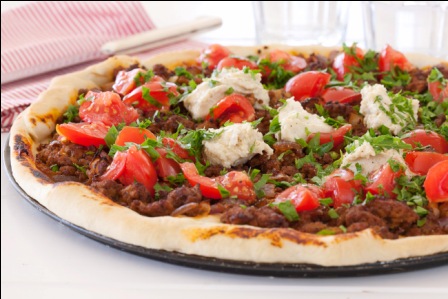
My 8 year old has just done her school speech on pizza – therefore I now know that they come from Naples and that the first recorded pizza was Napoletana, followed 30 years later by the Margherita –  originally made for the Italian Queen of the same name and the green of the basil, red from the tomato and white of the mozzarella all represent the colours of the Italian flag.

My early memories of pizza are not flash – in fact they are probably terrible.  We had pizza at boarding school for Saturday lunch and essentially it was scone dough with leftovers from the previous few days piled on top and a bit of cheese to meld the ingredients together…… essentially a lot of gloop that no self respecting Italian would ever use.

A self respecting Italian would also baulk  at ham combined with pineapple (according to my 8 year old) and goodness knows what they would say about teriyaki chicken or even worse a satay pizza!

Neapolitans take their pizza so seriously that an organisation has formed – the Assoiciazione Vera Pizza Napoletana, that defends and promotes the culture of the True Neapolitan Pizza in the world.   Their website is easily converted to English and is an insight into just has seriously Italians view their food!

Most would agree that pizza base must be thin – soft and pliable in the centre but getting crisper towards to the outer.   Ideally pizza dough should be made with  Tipo 00 flour – this is a very fine flour that is high in gluten.  It needs to be handled with some degree of gentleness in order to get a soft pliable pizza base, if overworked it can become tough.  As Tipo 00 flour is priced at  around $10 for a 1 kg bag it is probably best kept for special pizzas and instead use high grade flour when the kids and their friends are starving!
It may be worth experimenting with a mixture of Tipo 00 and high grade flour.

The pizza dough recipe that I make has the addition of olive oil for added softness (milk does the same), interestingly the Associazione Vera Pizza Napoletana permits only flour, water, salt and yeast in the dough.

Pizza needs to be cooked at an extremely high heat – my  dream is an outdoor woodfired pizza oven, but while I wait for that I will settle for setting the oven as high as it possibly can go and using a terracotta tile or a pizza stone.  These are heated in the oven first.   Sometimes when in a hurry I resort to the pizza pan with holes all over the base but the terracotta and pizza stone definitely cook a  better base.

The toppings on a pizza should not be mountainous and in fact if you visit a good pizzeria you will find that the toppings are moderate in quantity but hopefully high in quality.
The complexity of the tomato layer can change from a smear of tomato paste to something more sunstantial.  I generally place a can or two of tomatoes in the food processor with an onion, a few cloves of garlic, a slurp of olive oil, a small chunk of frozen pesto, salt and sugar.  This is pulsed until it is mush and then poured into a saucepan, brought to the boil and then simmered until thick.
This needs to be cooled completely before spreading a thin layer over the dough .  I make the same for pasta but reduce it more for pizza.

While my kids are still very simple ham and cheese eaters, I prefer prosciutto, olives, artichokes and slices of quality mozzarella.  Once cooked I then cover the pizza with rocket and basil leaves and drizzle with good olive oil –  although Ed thinks it odd that I am including the salad on the pizza?

What are some of your favourite flavour combinations?

My pizza restaurant recommendation in Auckland is That’s Amore in Auckland city, Alessandro is highly passionate about his craft.

Who else is making great pizza  around NZ?