Bargain Betty and the Pantry Project


Virgil Evetts

Diana Clement has a genius for frugality. She can spot a bargain at 50 paces, smell a decent garage sale from several streets over, and is a Trade Me trawler of formidable prowess. And so she should be. By day -and quite often night- she writes about personal finance and various consumer issues for the Herald, Consumer and several other publications in New Zealand and abroad. It is literally her job to know about money, spot bargains and cut costs.

Her fascinating and often hilarious adventures in bargain-ferreting can be found at http://www.bargainbetty.co.nz/ . Diana recently invited me, and by association Foodlovers, to help her with a simple but compelling project: to see how long she can feed herself and her two children from her well-stocked pantry, with minimal trips to the supermarket. As she puts it “One of the best ways to cut your grocery bill, at least in the short term is to simply not go shopping”. I certainly can’t argue with that, not in theory anyway.

It’s our shared contention that most people visit the supermarket far too often, and instead of creating meals based on what they have at hand, choose recipes and treat the ingredients as a shopping list. All of us do this to some extent, but it’s a long way from an economical approach. Even if you don’t go shopping on an empty stomach (a potentially disastrous rooky mistake) and actually stick to your list as dictated by Jamie et al, this day-by-day, piecemeal attitude will still eat a sizeable hole in your wallet. Take it from one who knows.

A more cost-effective and considerably less frustrating approach (assuming you’re not some supermarket-loving weirdo), is to maintain a well stocked pantry full of versatile, basic ingredients.  Not only is this a thriftier way of operating, it’s makes you a better cook. Anything that encourages an abandonment of recipe books and their inevitable rules and regulations can only improve ones craft.

Diana’s experiment in pantry-cooking is interesting, not just in terms of the basic economics involved, but also because it represents a reaction against how we cook and eat in the western world. Unlike the vast majority of our species, we of the affluent few do not eat whatever we have but whatever we want, or even more alarmingly whatever some lauded food writer commands. Somewhat conversely, certain well-intentioned food media phenoms and their espousing of ‘free-style’ cooking – as derived from rigid recipes- are really just creating another generation of cooks with a rote-learned, cook-by-numbers ethos. Pukka indeed.

The Experiment

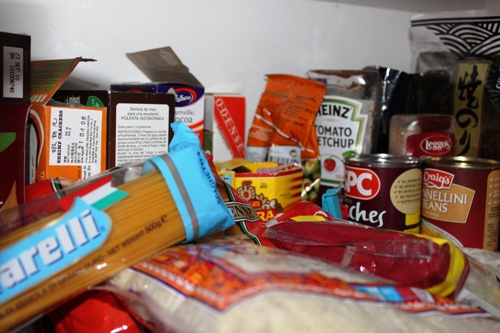
Last week I did a full inventory of Diana’s pantry, which I have provided below. Our job at Foodlovers is very simple: at the bottom of this article post either original recipes or links to recommended Foodlovers recipes which use items from Diana’s pantry. Recipes need to be family friendly, as Diana’s children Milo (7) and Maya (9) are still fairly conservative eaters –although by no means fussy.  At the time of writing Diana hasn’t embarked upon a major supermarket expedition (fresh fruit, vegetable and milk top-ups notwithstanding) for 3 weeks, and is showing no signs of malnutrition just yet. I have every confidence that we can help her to hold out quite a bit longer, and who knows, we might just learn a thing or two along the way.

Diana’s Pantry

Note: In the interests of encouraging creativity I have deliberately omitted quantities. Just assume she has enough…

Onions

Garlic

Eggs

Flour, baking powder, semolina, oats, etc

Cocoa, vanilla essence

Salt, pepper etc

Pinenuts, pistachios, sesame seeds, walnuts, raisins

Vita wheats, girl guide biscuits

Reduced Cream, coconut-flavoured reduced cream

Nori

Basic spices: Cinnamon, cumin, nutmeg, etc

Dried spaghetti

Instant noodles

Basmati rice, sushi rice

Mariumiya Japanese seasoning

Weetbix, Cornflakes, rice bubbles

Muesli bars

Potato chips

Soy Sauce, Worcester sauce, tomato sauce

Sesame oil, rice bran oil, olive oil

Balsamic vinegar

Milo

Peanut butter

Dhal

Instant soups – laksa, pumpkin and potato, tomato

Tomato paste

Stock powder

Tinned tuna, pink salmon

Anchovies

Canned fruit –peaches, fruit salad etc

Canned tomatoes

Frozen wedges, fishfingers, corn, asparagus, various frozen herbs

Canned pineapple

Beef schnitzel, lamb chips, frankfurters, kransky ,chorizo,  chicken burgers, prawns, lamb loin chops, beef mince, pork medallions, minute steaks, bacon

Pita bread, white and wholemeal sandwich breads.

Paneer

Pesto

Lemon juice

Cheese, butter, milk

Various fresh fruit and vegetables (replenished weekly)

Post your recipes, links and suggestions below and stay tuned for Diana’s updates…
You say pawpaw, I say papaya…

Virgil Evetts

It’s that time of year when seasonal fruit are all but absent from the garden and fruit shop unless you count citrus, which I’ve now had my fill of well and truly. And don’t insult me with  mention of California stone fruit either.

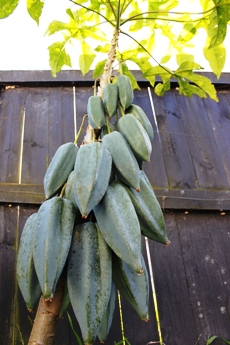
Normally around now I’d be harvesting bananas but the summer drought dissuaded my trees from flowering this year. Thank God then, for that queen of the cool-climate papaya clan, the Babaco. My tree is currently holding about 20 kilos of the dusky green torpedoes, and is thoughtfully dispensing them to ripeness one at time.

There is a great deal of confusion about the names of the various plants called pawpaw and papaya in New Zealand, so here’s my attempt to offer some clarity on the matter. Irrespective of which member of the papaya clan you are dealing with, they are a fruit for unadulterated enjoyment only, except, perhaps, a little sugar in the case of the babaco, and limejuice with tropical papaya.  Do not bake with them, do not bottle them; just enjoy their simple charms unaffected.

Babaco (Carica pentagona)

The babaco is a natural hybrid between a couple of varieties of mountain papaya, but unlike its parent species (a rather underwhelming lot) is a headily fragrant, juicy and flavoursome charmer. Not only is it a welcome supplement to the mostly fruitless winter/spring cusp, but it’s a sensational fruit in its own right. The trees produce fruit all year around but the winter crop tends to be the heaviest.

It’s only fair that I warn you though; babaco do not taste anything at all like tropical papaya. Despite appearances and DNA, they are different beasts entirely. Although comparisons never do justice, the closest I can think of for a babaco is a pineapple crossed with a honey dew melon – but not so sweet. Like all of the papaya clan, Babaco are packed full of vitamins and dietary fibre. They also contain high levels of papain, an enzyme which assists with the digestion of animal protein.  Rather like grapefruit, fresh Babaco is greatly improved by the addition of a little sugar.

There are other hybrid species out there – notably Rainbow Valley and Pabaco.  As yet untested…

Papaya (Carica papaya)

This is the true tropical papaya, as found in supermarkets and fruit shops nation- (and indeed world-) wide. They can be either red- or orange-fleshed, with the latter being the most commonly available in NZ.  In my humble opinion, red-fleshed papaya is by far the better of the two, but I’ve yet to find it outside of the tropics. Influenced by her childhood in Samoa my mother always prescribes fresh papaya for an upset stomach – and very effective it is too. Medicinal properties aside, the papaya is a delicious tropical fruit but sadly it doesn’t grow well in New Zealand. That said, the seeds from those supermarket fruit germinate easily and the plants will grow up to a metre high over the summer months. The trick is getting them through a winter and producing edible fruit.  A few years ago, and after much molly-coddling, I harvested one very small fruit from a tropical papaya grown in my greenhouse before the tree changed sex (as they are wont to do), and I lost interest. You never know your luck though…

Mountain Papaya (Carica pubescens)

Common in gardens all over the upper North Island, theses plants look wonderfully tropical but the fruit is only really edible in the very loosest sense of the word.  Shaped a bit like a small, deformed rugby ball they are more seed than fruit and pack a rather fetid,  gastric aroma and an oddly tomatoe-y flavour. The fruit  makes great chicken food though. Anything labelled as a pawpaw or papaya at a garden centre in New Zealand will probably be this species.  Caveat emptor ,and all.

Pawpaw (Asimina triloba)

Although widely used to describe various papaya (carica)species in New Zealand, the name pawpaw actually belongs to a North American fruit related to the cherimoya and soursop. The true American pawpaw is a delicious custard-fleshed fruit with a rich tropical flavour reminiscent of bananas, mango and pineapple. Native to inland parts of North America it can tolerate quite extreme cold (minus 25 Celsius!) and should perform nationwide. That this fruit has never caught on is a mystery to chefs and nurserymen/women worldwide.

All of the plants described here and many, many more are available from Subtropica Nurseries in Waipu. Claire will happily ship plants nationwide.

http://www.subtropica.co.nz/index.php

Also see Russell Fransham’s excellent catalogue at

http://www.subtropical.co.nz/catalogue2.html

Russell is probably New Zealands’ most knowledgeable guru on all things subtropical and really nice guy to boot.

Of Cabbages and Kings (but mostly cabbages).

Virgil Evetts

To the average consumer there’s nothing very sexy about brassicas. Oh sure, we go through the motions with broccoli and cauliflower and even the odd cabbage from time to time, but they’re  usually approached  with grim determination rather than drooling anticipation.  The trouble is,  I think, many of us are still haunted by the cabbagey legacies of our recent ancestors Continue reading

A Sow-er taste in my mouth…

Virgil Evetts

Have I learnt nothing from my various philosophical run-ins with religious zealots? Extremists of all persuasions issue decrees and dogma, not reason and sound debate. They are best avoided. Despite knowing this only too well, I was recently drawn into a Facebook discussion about a very topical animal welfare issue – sow crates. I will not name the host organisation because I admire their work and have no wish denigrate them in any way.  It was a minority of militant hangers-on that I fell afoul of and with whom I take issue here.

Initially I only posted in defence of another contributor who had been accused of ‘murder’ for advocating the consumption of free-range pork as opposed to no pork (or meat for that matter) at all. Here is what I actually said:

 ”Murder…really? Are we still rolling out that old chestnut? Human evolution has largely been driven by a need for animal protein, which due to our physiology is the most practical source of the calories required to build muscle and fuel thought. Murder and following one’s dietary imperatives are very different things indeed. I strongly advocate a boycott of conventionally raised pork, but not meat altogether. The only reason such deplorable farming practices continue is because consumers tolerate them. Farmers are essentially business people and you cannot expect them to do anything that isn’t profit driven, especially if it is above and beyond what the law requires. Conventional pork farming as it stands is more economical than free range, and it is perfectly legal. I don’t like it either, but then I can afford the alternatives. Many consumers cannot.” Nothing very profound there, but a valid enough opinion, I thought.

The responses which followed reminded me why legitimate liberal causes have such a tough time winning conservative support and affecting significant change. Time and again they are hijacked by ill-mannered and ill-informed attention-seeking idiots.

To capture the general spirit of the many, many angry responses my post received; I too was accused of murder- never mind that word being a legal term, not a general behaviour. My accusers would settle for nothing less than a meat-free future, and argued that all thoughts and actions to the contrary were inherently cruel, nay evil and abusive. They dismissed outright contemporary (and very, very strongly supported) evolutionary theory, and raised bizarre claims about our species gastric prowess, such as:”Humans can digest anything (including cardboard) but that doesn’t mean we should” and “Are you comparing yourself to a cheetah?” Ummm, no we can’t and no, quite clearly I am not.

This left of left-wing bovver-boy attitude is the (humanely euthanized) albatross around neck of so many worthy causes. I consider myself to be pretty broad minded, left wing and even reactionary at times. I’ve avidly supported workers’ rights, gay rights, women’s rights, animal rights and so on all my life. Always will. However, I learnt a very long time ago that shouting at people really doesn’t achieve much. Eventually they stop listening to anything you say and your moderate supporters (i.e. the majority of your supporters) drift away. All that remains is a small, Leighton Smith-baiting, braying minority. As much as any cause needs an advance guard willing to take risks and grab public attention, eventually reason and intelligent debate must prevail.

I am passionately committed to the welfare of farmed animals and the implementation of humanely driven codes of practice within the meat industry. However, I eat meat. I like meat, and that’s not going to change. Does that make me a traitor to the cause? Is this an all-or-nothing debate, and if so, are there enough true-believers to actually affect any meaningful change?

I object to being painted as a murderer simply because I choose the default human diet and I fear for the future of farmed animals if they are only to be championed by inflexible, cause-killing bullies.

But it looked so good in the picture!

Debbie Byrom

I don’t often eat ice cream. Especially the fat-laden sugary behemoth that is a Memphis Meltdown – I’m afraid I may be afraid of big nuts as the advertising suggested. There was however a moment of weakness on an unseasonably sunny day last weekend and I found myself leaning over the ice cream cabinet in the local gas station. I got suckered by a ‘new’ sticker.

There are two kinds of people on this earth – those who like their ice cream plain (vanilla, hokey pokey etc) and those who think the more bits and pieces you add the better. I’m firmly in the second camp. Or at least I was. Enter the Rocky Road Memphis Meltdown. The description on the pack goes something like “A mountain of jelly rippled chocolate ice cream dunked in marshmallow and smothered in choc, nuts and coconut”. The mother in law, who also got suckered in, described it as being like eating a jandle.

It wasn’t that there was anything wrong with it as such. The individual components were fine (excluding the marshmallow which was like cloudy tough jelly) but the ultimate combination was wrong – too much other stuff, not enough ice cream, the whole thing was barely even cold.

I feel the need to add in a disclaimer at this point in the defence of Tip Top. Other people might love the product, it just didn’t do it for me.

Anyway, I was so disappointed that I got halfway through, gave up and put the thing bag in the bag, dropped it in the nearest bin and proceeded to sulk. For some reason food has an astounding ability to upset me; I feel cheated and let down in a way that is neither reasonable nor rational. It’s been happening a bit recently – Pak’ n Save steak that tasted not quite right and my first tasting of Collective Dairy yoghurt which just couldn’t match up to Piako.

Surely I am not alone in being lured in by the look of something to find that the reality is far less fulfilling. Anyone got any good examples?

The curse of the night owl

Virgil Evetts

From my mid-teens through to my late twenties I was a consummate late nighter.  Lights-out at 2am was quite the norm on weekdays, and weekends were much, much worse. I don’t know how I did it. But then age, work and my general softness took their toll. Bed times crept back until I literally couldn’t stay awake much beyond 10pm. Although a bit boring, and alarmingly indicative of the onward march of decrepitude, I certainly felt better for a good night’s sleep.

But now, in my mid 30s, with my baby brother in law (he of the frock coats and black nail polish) recently having left home and a real baby only weeks away, I seem to be regressing. Despite my good intentions, I find it all but impossible to get to bed before midnight again.

The main problem with staying up late is not tiredness the next day, which so far hasn’t been too dreadful, but the fact that the sated affects of dinner wear off around 11pm.  Hungers beckons, gnaws and nudges.  There are always leftovers in the fridge, but I don’t do sequels. So I’m forced to graze the pantry, usually making do with whatever salty, fatty and sometimes sweet convenience-morsels I can lay my hands on.

Cheese and crackers are a common choice – usually in the company of our neighbour’s excellent feijoa chutney; I’ve been enjoying a bit of a crumpet revival lately too… a fine thing, a toasted crumpet, especially spread thickly with Kaya (coconut jam) or honey; and if I’m feeling really desperate (i.e. no crackers or crumpets on hand) I’ll raid my precious stockpile of frozen roti, usually reserved for Thai curry nights. These are very good drizzled with kecep manis and sesame chilli oil…

But the thing is, none of these quite satisfies me enough to quell greedy thoughts for long. I could cook something I suppose, that might do it, but I hate going to bed with cooking smells lurking about the place.

There are many schools of thought about what foods are good to sleep on too. Some based in rational science (e.g. sugar and excess carbs really are stored as fat if you don’t burn them up quick-smart) and others based on nonsense superstition and weird Englishness e.g. cheese gives you bad dreams.  But to be honest, when the late night hunger horrors find me, I couldn’t care less about side effects.

It’s perhaps a good thing then that I have at last found the perfect, late night snack – and as a happy accident it’s a healthy one too. Well sort of/probably not at all.

In my latest attempt to start eating breakfast, I test-drove a number of  cereals. Overall they were just as I remember them being from my childhood i.e. a pretty ‘meh’ affair. Until I discovered granular love in the form of a certain very-well-known brand’s berry-laden-muesli-cluster-and-other-nice-things  mix.  Ok it’s Sanatarium’s Cluster Crisp Triple Berry,  and before any of you get antsy about covert advertising etc, I’m volunteering this opinion entirely unsolicited. Of course, if the good people at Sanatarium wish to furnish me with an unending supply of their product, that would be just fine.

Anyway, suffice to say, this cereal is very, very good indeed. Well I think so. It includes a great variety of mostly toasted grains and delicious freeze-dried fruit, all bulked out with too-too-good berry-juice-soaked clusters (of oats, I think). For reason of economy and potential obesity I strictly ration myself to two bowls and two bowls only per day: one in the morning, and one last thing at night. Well that was the plan -turns out I really don’t do breakfast, even when it’s terribly good. So now my late nights are capped off and complimented by two large (my rationing never stipulated volume) bowls of cereal. Satiating perfection.

I also hear good things about porridge at 4am.

The Exploded Chicken

Virgil Evetts

So ubiquitous is the humble chicken among the world’s myriad cuisines that it has become the default point of reference for all other meats. Any unfamiliar flesh is described in terms of how much it tastes like chicken.  I think this is more to do with  lack of imagination and largely mediocre experiences with the bird than any real truth. For example, having eaten a lot of very good chicken in my time, I can assure you quite categorically that neither frog legs nor crocodile taste anything like it. Continue reading

When the durians fall down the sarongs go up…

Virgil Evetts

…Or so says a rather pervy old Malay saying about the apparent aphrodisiac properties of the world’s most polarising fruit.  Well, the durian are down right now (meaning it’s Durian season in South East Asia) and my sarong is wholly undisturbed, because the only thing the durian stirs in me is a desire to eat more durian – even if I don’t really understand why.  The weird blend of onion, sewage, and various tropical fruit which makes up the flavour profile of a good durian should repel – and indeed initially did so in my case – but repeat exposure  has engendered  love and something nearing addiction. That fragrance, which I literally used to cross the road to avoid in Singapore, Thailand and Malaysia, now draws me in like a moth to a spiky and odiferous flame.

Fresh durian are currently available from Asian fruiters around the country, along with their traditional partner, the truly exquisite mangosteen.  While the latter are widely regarded as the finest of all tropical fruit, and are bound to please and delight even the most conservative palate, I don’t advise the durian virgins amongst you to rush out and purchase an entire fresh fruit;  they are about the size of a large melon, staggeringly pungent and lavishly expensive ($25+ each).  It’s a sizeable waste if you don’t like it. Frozen durian – either whole or in segments – are a far more affordable option, and can be found at any good Asian supermarket.  The frozen fruit retains most of its creamy, custard-like texture, and all of its strange, complex and quite compelling flavour.

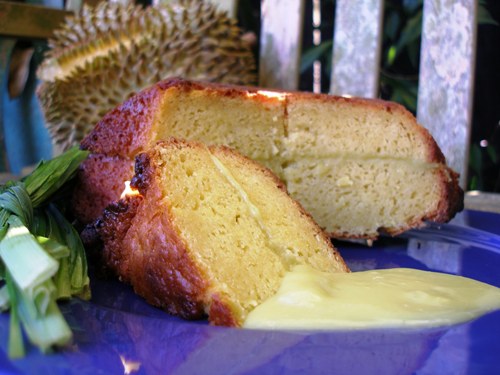
This season I finally got around to making a traditional Malaysian durian cake, based on a recipe I picked up in Kuala Lumpur a few years ago. Why, oh why did I wait so long? Apart from being a beautifully moist sponge in its own right, the sugar, butter and eggs  miraculously obscure the rougher aspects of the fruit and accentuates its finer points- which are legion.  The result is a tender, golden sponge with a brittle, buttery crust, an exotic fragrance, and a complex, indefinable flavour.  

Now, I don’t honestly expect you all to rush to your kitchen and make this cake – too alien and scary to most I know; but consider it a novelty read if you like, or  if you dare, something to whip up when you really want to make a mark at your next tea party.

I’ve tweaked the quantities and method a bit from the traditional Nonya original to make it behave in a standard oven, and have added a rather cheeky little pandanus cream filling. If I do say so myself. Pandanus leaf is commonly used to flavour desserts (and occasionally savoury food) throughout South East Asia. It has a lovely, heady fragrance reminiscent of vanilla, coconut and jasmine rice.  Even if you don’t make the cake (and I bet you won’t) , try the filling with pancakes or crepes.  If I was going to nominate any ingredient as the next big thing it would be pandanus. Quite exquisite stuff and deserving of far more attention than it gets around these parts.  Frozen pandanus leaves are available from most Asian supermarkets.

Durian cake with pandanus cream filling

Cake:

3 eggs

170 grams durian flesh or pulp (frozen or fresh)

170 grams plain flour

170 grams butter

170 grams sugar

2 teaspoons baking powder

2 tablespoons coconut cream


Pandanus cream filling:

½ cup sugar

2 tablespoons cornflour

6 pandanus leaves

1 egg-beaten

1 cup hot water

2 tablespoons butter

¼ cup cream

Pinch of salt

To make the cake

Cream the butter and sugar until smooth and pale, slowly add the eggs and then the durian, mixing all the time. Now carefully fold in the flour and baking powder with the coconut cream. The mixture should look slightly curdled and lumpy.

Pour the batter into a well buttered cake tin and bake for about 45 minutes at 180C or until a wooden skewer comes way clean when poked into the centre of the cake

Cool on a wire cake rack.

To make the filling

In a food processor or blender pulse together the pandanus leaves in the water until finely chopped. Strain the mixture into a small bowl through cheese cloth or a clean tea towel. Squeeze firmly to extract as much juice from the pandanus as possible. Discard pulp.

In a small pot mix together the strained pandanus water with the sugar and corn flour. Bring to the boil, stirring constantly. Slowly pour in the egg, and continue to stir. Add the butter, cream and salt. Stir until thick and silky. Remove from heat and allow to cool.

To serve the cake, either slice horizontally and spread the filling thickly on the bottom layer before replacing the top, or leave the cake intact and serve the filling on the side.

I’ll think very highly of you indeed if you try this out. Go on…

The Pesto Manifesto

Virgil Evetts

I’m breaking with convention this week.  No more seasonality.  Enough already.  I know it’s bitterly cold out, but there’s only so much slow cooking I can handle.   I don’t like winter, not one bit, and over exposure to slow-cooked stew-y things just reminds me of how far we are from summer.  I find pesto in its various forms and uses a perfect midwinter tonic. Continue reading

There’s a fly in my soup… if I’m lucky.

Virgil Evetts

Let’s be honest now, nothing ever really happens in New Zealand, so the most trivial things attract media attention. Remember how long that escaped otter led the evening news? Last week saw another instalment of that perennial favourite of local news hounds: ‘attention seeking shopper finds bug in processed food’. This time it was a rather bedraggled wasp in a can of soup. These stories pop up at least a couple of times a year and stick to a tight predictable formula: cheeky/alarmist headline, the company assures customers that it was a freak occurrence and the ‘victim’ is always ‘shocked, disgusted and appalled’. And evidently quite naive.

Because I abso-bloody-lutely guarantee that all of us consume various bits of insects, spiders and possibly worse in our food on an almost daily basis. We are never further than around 30cm from invertebrate life, so as you read this there at least one multi-legged creeping thing within arm’s reach. So is it really any surprise that some of these end up in our food? The American Food and Drug administration have some rather alarming statistics to back this up if you don’t believe me.

But should we even care? In the case of well-cooked wasp I would say not. They’re pretty clean insects (I suppose a wasp-sting allergy could be a problem), and any associated bacteria will have been stopped in it tracks by the pasteurisation. It’s all very well to say that nothing should make it past the rigorous screening processes on the production line, but fact is, most insects are small. There is no way to thoroughly check every millimetre, of every item of produce. There will always be bugs in processed food. Not many, hopefully, but always a few. But ideally by the time we as consumers get anywhere such food, these unwanted guests will have been fragmented beyond any recognition.

However, I have more trouble when such stowaways turn up in restaurant food. Just last week I was working my through a bowl of fried udon at a clean and reputable Japanese restaurant, when I removed what was left of a rather large beetle thorax from my mouth. It was very crunchy and tasted peculiar to say the least. I looked carefully through the rest of the dish, but no more beetle. Thing is, I was very hungry, we were very pressed for time and the staff spoke very little English. I could have quite legitimately made a fuss. But I’m a little ashamed to admit that after a moment’s hesitation, I just kept eating. It was only a beetle after all. Not as bad as the cockroach I once found in a meal in Singapore, or the used plaster a friend once recovered from her mouth while sculling soup from a very well-known cafe.

But none of these compare to such great urban myths as the Kentucky fried rat, the cola mouse or the severed finger in the frozen peas. I’d love to get my hands on any of these as I’m pretty confident the companies concerned would pay through the nose to shut me up. What’s the strangest thing you’ve ever found in your food?

Warming The Cockles

Virgil Evetts

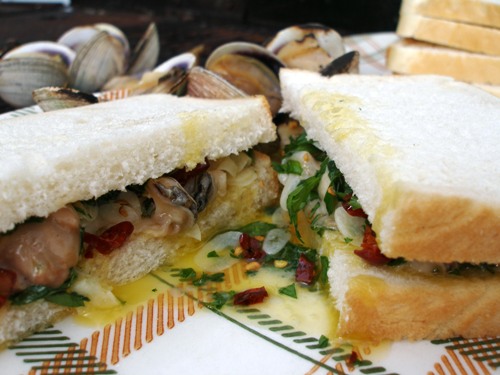
Is it terribly un-Kiwi of me to admit that I can’t stand oysters? The way they smell, they way they taste, the way they slither down your throat with slug-like viscosity… my stomach heaves.  I’m not much moved by mussels either – too obvious.  No subtlety to a mussel.  And as much as I swoon for the milky sweetness of fresh scallops, they don’t return my love; Continue reading

Fair Suck of the Sav

Debbie Byrom

Seems to me the Sav has had its day. We’ve been drinking Sauvignon Blanc like it’s going out of fashion for the last 10 years or so, and now, well now it is going out of fashion. While there have always been people who have been less than a fan of the ‘cat’s pee on a gooseberry bush’ flavours, anecdotally it appears that more people are adopting an anything but Sav stance – entirely reminiscent of Chardonnay’s fall from grace in the late 90’s, early 2000’s. Perhaps it’s not too late, so far I haven’t heard of any children called Sauvignon, something tells me that was the death knell for Chardonnay.

The whims of the group mentality of wine drinking are fickle and those of white wine drinkers in particular even more so. This must be the price to pay for being the entry point to wine drinking; when you are the drink of choice of the fashion conscious female you are going to have to live with being out of fashion. Women seek new things and those things which are common are generally viewed as being less attractive. Men are comparatively more comfortable to be part of a group hence the longevity and strength of beer brands and their drinker’s loyalty. Like most social trends the change will be measured in years rather than months. Have you noticed over the last couple of years a slow insurgency of Pinot Gris? This, the white bread of wines, notable for having a flavour which is inoffensively absent of flavour.

Chardonnay also seems to be experiencing something of a comeback and it has evolved into the white of choice amongst those who consider themselves thinking drinkers and above the whims of fashion. Except all the thinking drinkers seem to be doing the same thing. The thing is, whether you like it or not, what you choose to drink says something about you – and more often than not you will choose to drink something different when you are out at a bar than you would normally drink at home. Alcohol choice is one of the most conspicuous forms of consumption, one of the most highly image driven and consequently one of the most easily stereotyped. Can you get an image of who might drink a fruity vodka RTD? A Woodstock and cola? A Stella Artois? A Canterbury Draught? The most socially acceptable drink for the average woman is white wine in what ever varietal is the most popular at that time. You’ll find the biggest selling wine at pretty much any bar is the second cheapest Sauvignon Blanc; the Toyota Corolla of beverages. One of the interesting things is that past the first sip most people don’t really taste what they are drinking. In beer it’s even worse – some people will swear black and blue that they only drink one brand and the others taste like (insert expletive of your choice). In a blind taste of three lagers the average drinker is no better at naming a brand of beer than chance would dictate. It’s the ultimate example of style over substance. Not that there is anything wrong with the substance of course. If you enjoy it and it makes you happy what is really wrong with identifying with a brand based on its image rather than on its product? The only issue is that we all think that we are smarter than to buy into the hype.

Unfortunately there are so many products out there that prove that that’s not true. A different category but a good example none the less – Chit Chats, apparently, always win hands down in blind tastings but Tim Tams are far and away the bigger seller… So what do I drink and what does it say about me? I tend to drink beer over wine and usually it will be a slightly more unusual beer – by which I mean not a lager or it’s slightly browner more traditional kiwi cousin. If I do drink wine I’m quite partial to a Gewürztraminer, I will admit thought that when forced to pick in a hurry or around people I don’t know I revert to the second cheapest Sav. If I’m going to be brutally honest I’d want someone to look at my drink and think to themselves “Hey, that girls not drinking the second cheapest Sav, maybe she’s an interesting and vibrant individual snowflake”. But then again, I do drive a Toyota Corolla.

Peppers, peppers burning bright…

Virgil Evetts

It might seem a funny time of year to be talking about preserving sweet peppers, but it’s been such a strange season. My plants (Spanish Pequillo) gave up what will probably be their last major crop for the season only last week.  Even now the odd fruit continues to ripen.  I’m guessing others in the north will be seeing similar backyard oddities this year.

I hardly ever eat any of my peppers fresh, mostly because the variety I grow have very tough skins, but also because I think they just taste better preserved. It’s a bit like the difference between milk and cheese I guess. But I don’t mean just any method of preservation. Vinegar is brutish stuff and obliterates the complexity and finesse of a good pepper. Drying is fine if you plan to use your peppers in soups, stews, stocks or ground into homemade paprika, but the very best way, with the most versatile results, is strangely little-known and rarely practised in these parts.  Effectively just a stripped back version of the water bath method, it has been used around the shores of Mediterranean for hundreds of years.  It can be used to preserve many other fruits and vegetables (and even tuna!).

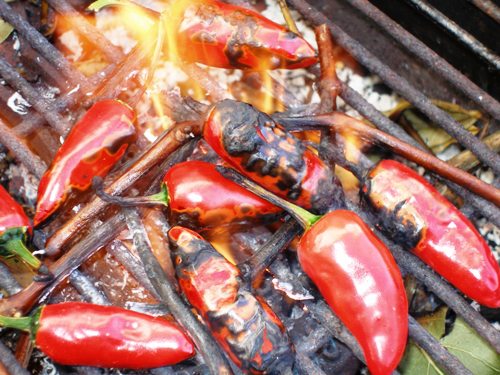
In the case of peppers, the process starts off in a very primal way, with the cleansing lick of the flame. Pepper skins are literally indigestible to humans and pretty unpalatable too. The only practical way to be rid of them is by chargrilling.

This can be done under the grill of an electric oven or directly over the flame of a gas BBQ, but for the best results you need the subtle seasoning of wood smoke. There is no need to get an actual pyre going in your backyard – this is probably illegal where you live anyway and takes forever to get going anyway.  My preferred short cut is to drop down the grill on my gas BBQ until the flames are licking through, and then make a small pile of twigs (grape and fruit tree prunings work really well) ontop. Lay the peppers (whole unless you want to save the seeds) on the twigs, and keep turning them until blackened all over. The idea is to scorch the skin not immolate the fruit, so don’t wander off at this point. The twigs will burn down fairly quickly so keep replenishing. As individual peppers are ready, drop them into a waiting plastic bag and cover them up. The steam inside the bag will help loosen the skins later.

Once all your peppers are burnt black and bagged, leave them to sweat it out a bit. About 15 minutes will do.

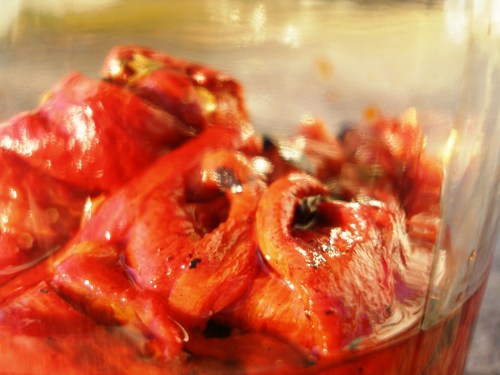
Next, under a running tap, slip the skins from the peppers – they should come away very easily – and pull out the core. Rinse away any loose seeds or flecks of burnt skin. Now firmly pack the peppers into preserving jars with sealable metal lids, and top with a few basils leaves and a teaspoon of salt to each cup volume of peppers. Seal the lids very tightly. Wrap each jar in either newspaper or a tea towel (this prevents breakages), and submerge in a large pot of water. Bring the water to the boil and continue to boil for 20 minutes. Remove pot from heat and allow to cool.

Once cool, carefully unwrap each jar, dry and briefly invert to ensure there is no leakage.

The peppers will have lost volume and will not be fully submerged in the pepper syrup that has formed. This is quite normal. Don’t worry. Until opened, the peppers will remain completely safe and sterile.

These peppers can be used immediately but improve with age. They keep unopened for at least a few years and probably much longer.

I use my preserved pepper on pizza, tossed through pasta, in salads, on toast, crackers, pretty much anywhere and at anytime. They are my most treasured pantry item and I’m very loathe to share them.

Tiramisu, Tira-you-su

Virgil Evetts

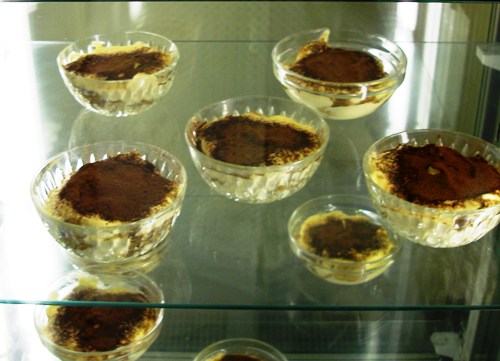
In terms of food fashion, this article is probably about 20 years too late. Tiramisu has long since passed from being the darling of the supper club set to mainstream world domination. Few chefs in high-end eateries would dare present it to the punters today, except perhaps as some clever deconstruction or hybrid. Continue reading