The Virtues Of Snacking

Virgil Evetts

I don’t know about you, but I just can’t go anywhere near the supermarket on an empty stomach. I’ve done it a few times and ended up stumbling around the isles in a starved stupor, eventually getting home to find I’d bought a trolley load of mismatched food – mostly pricey, instant gratification, caloric rubbish – that I didn’t really want. So I have learned to either shop on a full stomach, or leave the shopping to someone who can be trusted to stay within budget and reason. My best beloved is good in this regard, being largely immune to hunger-driven lapses of taste.

But hunger doesn’t just make me a weak-minded trolley pusher: it also leads me seriously astray in the kitchen. The whole decision of what to cook becomes an unbearable burden on an empty stomach, and I throw myself into perspective-challenged despair. I’m told it’s quite the spectacle.

So the bottom line is that, after feeding the cats and checking the chickens, the evening can’t possibly get going until I’ve refuelled with a light but tasty snack. Being a very fussy eater – and I mean VERY fussy – I have high standards for my snack foods. But (and here’s the rub) it has to be super easy to assemble (certainly no cooking involved), taste great and go well with wine.

Now let me just say that I do realise everyone has their own favourite snack foods – some prefer sweet, some prefer savoury, some like it wet, some like it dry – so I’m not trying to say that this is the definitive list, it’s just my definitive list. This is just the stuff the puts the wind back in my sails after a long day of toil, so I can get on with the more serious business of my nightly cook-fest.

Cheese

By far the easiest option when you walk in the door, and just about my favourite food full-stop.

The only downside to cheese is that it’s a bit on the fattening side. I blame my mid-20’s waist expansion on the double cream brie addiction I was trapped in at the time. Not that it stopped me.

Cheese is however the very best kind of snack food because it’s salty, fatty and high in protein, thus giving your worn out body a gentle kick in all the right places. I go through phases of preferred pre-dinner cheeses, but usually vacillate between brie, something blue and creamy, and good, crumbly cheddar.

Ideally all cheeses should be served at room temperature, but after work on an empty stomach, who has the time to wait?

I usually prefer my cheese served with water crackers – these add some much needed carbs, but don’t interfere with the cheese’s complex flavours. If I’m really lucky my best beloved will have treated me to some criminally good and fiendishly expensive Duchy Original oat cakes. Made from ingredients grown organically on the estates of dear old Prince Big Ears, these are a serious weakness of mine.

Brie is not a cheese that needs any further accompaniments – it’s too delicate for this sort of thing – but I do like a bit of chutney or relish with my cheddar. Sticky, sweet Indian green mango relish is particularly good. Unlike most cheeses, which are sold prêt a manger (ready to eat), brie requires a bit of planning. Because I like my brie very ripe – as in ammonia-scented and oozing – I always buy it several days before I intend to dig-in. Kept loosely wrapped in the pantry it quickly ripens to that perfect degree of solid/liquid bliss sticky bliss.

A nice ripe blue cheese is just fine on its own, but a little honey comb (If you can be bothered with all that wax) or quince paste is always most welcome.

Fromage fort –when I have it – certainly makes the grade for my 5:30 top-ups and goes exceptionally well on warm toasted ciabatta.

Nuts

As I covered nuts ad nauseum not so long ago on Foodlover’s , I won’t bore you with too much detail here.

A bowl of pistachio nuts is probably about the laziest sort of snack food, but it’s also among the most delicious. But, as I’ve already confessed, I have no self control whatsoever when faced with any quantity of pistachio nuts. I will keep eating until they are all gone, however ill it may make me feel. Don’t look at me, I’m disgusting.

Being in the thrall of the pistachio not only plays havoc with ones inner workings, it also does serious damage to the war-chest. They’re prohibitively pricey and therefore only a very rare indulgence these days.

Peanuts are a more affordable option and with a little effort can make a surprisingly snazzy snack. To make spiced peanuts, heat little oil in pan, toss in 2 cups of blanched, peeled peanuts. Stir the nuts until well browned. Add a teaspoon each of garam masala, ground cumin, salt and a generous pinch of ground allspice and stir until evenly coated and fragrant. Remove from heat and drain on kitchen paper. Serve completely cooled to get a decent crunch. These nut can be little messy to eat, but are a cheap and easy way of injecting the total yawn-fest that is the peanut with some much needed verve.

Crostini

These take a bit of initial effort but are welcome addition to the pantry when hunger busts the door down. Crostini are nothing more than thin slices of (usually stale) bread, drizzled with a little olive oil and baked in moderate oven until completely dry. They should be very brittle and crunchy. In an air tight container they will keep almost indefinitely – willpower permitting.

Crostini are great smeared with whatever you have in the fridge – pesto, taramasalata, aioli etc. My favourite topping for crostini is fresh chicken liver pate made in the Tuscan style with a few anchovies and capers blended in with the livers. Just about as fine as snacking gets and the kismet- perfect partner to glass of blood & guts red.

Bruschetta

First of all, I have to clear something up. It’s bruu-sketta, not brush-etta. I know, it doesn’t really matter, but what can I say – I’m a total pedant.

Anyway, bruschetta is really just garlic bread with an Italian flourish. Best made with Italian-style sour dough bread, such as ciabatta or pugliesse (fluffy, soft breads will burn too quickly), cut to the thickness of a couple of fingers and toasted until it to burns a little around the edges. The bread is then rubbed with a clove of raw garlic, drizzled with some very good extra virgin oil and finished with a sprinkle of flaky sea-salt. I’m not a big fan of the lingering taste of raw garlic, so usually blanch it for about 10 seconds in the microwave first. Not often you’ll hear me mention microwaves with any kind of positivity.

Bruschetta is traditionally grilled over charcoals. Yeah, whatever.

Corn Chips & Salsa Cruda

There is something about the smell of cheap corn chips that I just can’t abide. So strong is my aversion that I’ve banned their consumption in my presence at home. EMO –Boy (my brother in law) on the other hand would quite happily subsist on the noxious shrapnel, and is forever testing my boundaries. He got quite snippy the other night when I exiled him back to his fortress of solitude (his bedroom), after he briefly surfaced with a sack of said stinkables. What is it with gangly students and peculiar smells?

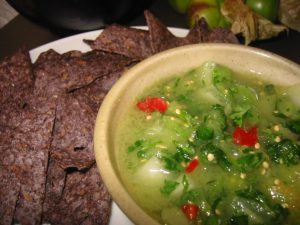
But being a card-carrying hypocrite I do make the odd self-serving exception to this ban. Blue corn chips can do no wrong. I’m such a fan of these, and not because they are organic or blue – they just taste, and smell, really good. Blue corn chips are made with a naturally blue variety of maize grown for centuries by the Native American Hopi people. They have a wonderfully toasty, mellow corn-flavour (the chips, not the Hopi), but with none of the sickly, sweaty odour I find so disagreeable elsewhere. Basically these are the corn chips for people who don’t like corn-chips.

To make an a perfect salsa cruda (raw sauce) to accompany these, or any other corn chips that tickle your fancy, roughly process together 2 or 3 peeled and burstingly-ripe tomatoes, a clove or 2 of garlic, a couple of chillies, a de-seeded red capsicum, a glug of olive oil and plenty of salt to taste. Use your fingers to squish together but do not use a food processor. Finish with a little fresh coriander. This should be a rough, chunky sauce with a zingy freshness from the raw tomato and good kick from the chilli and garlic. When you can find them, tomatillos make an excellent substitute (pictured) for the tomatoes. The tomatillo version is known as salsa verde, but shouldn’t be confused with the very good but complexly different Italian sauce of the same name.

As you might have noticed, none of these ideas is exactly innovative or original. But that’s because when I’m really hungry I don’t want to think, I want simple pleasing flavours that recharge my batteries, so I can focus on the real matter at hand-dinner!

There’s nothing wrong with going to lots of effort with your snack foods, but it’s often wasted on the tired and hungry.

In my professional life I attend a great many gallery and exhibition openings. Quite often the catering for these affairs is very lavish indeed, with an endless array of very clever, very fussy canapés and amuse bouche sweeping through the crowd. As most of these events happen in the very early evening, the assembled company is usually desperately hungry, and as result virtually inhale whatever they are offered. I often think they’d be just as happy with sausage rolls and curried eggs. So ultimately, my personal golden rules for après toil pick-me-ups are: keep it simple, keep it quick, keep it tasty.

So what do you think? Are you a snacker by nature ?
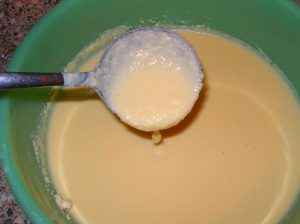
Fromage Fort- And Won.

Virgil Evetts

Fromage fort- meaning strong, or possibly fortified cheese- is an exercise in frugality that only the French could have dreamt-up.

Conceived, no doubt as way of using left-over cheese scraps and wine-dregs this ancient Gallic delight is sadly almost unknown to the outside world (it doesn’t even have a Wikipedia listing for cryin’ out loud).

Best described as a very sophisticated, winey cheese spread or dip, fromage fort is reminiscent of the best fondue but without the corn-flour viscosity and key-party connotations. It can be made from pretty much any cheese (but be warned, the blue cheese versions are  not for the faint hearted) and usually has the slightly tingly, almost peppery bite of active fermentation. I’ve made fromage fort  on and off for several years now, and as I’m currently working  through a particularly decent batch,  I thought it was probably about time I share.

Because the main ingredients of fromage fort- cheese and wine- are essentially alive, the finished product is never the same twice. And like both of its parents, fromage fort needs time to fully mature.  This is my favourite sort of food- living, breathing, and quite unpredictable. Come to think of it, that’s my bottom line for people too.

Fromage fort

Fromage fort can be made in any quantity. I don’t use ‘cheese scraps’, simply because such a thing is unheard of in my house. Instead, I buy whatever tasty cheese (cheddar) is on special and use whatever white wine- usually chardonnay- I have on hand. I’ve also made it with my homemade apple wine (no, not cider, but that’s a story for another time…) with great results.

Grate the cheese and using a ratio of 2 parts cheese to 1 part dry white wine, and with a little butter blend to a smooth paste.  Fromage fort should have the consistency of a very thick soup, so don’t hold back on the wine. Pour into a non-metallic bowl and cover with cling film. Store at room temperature and out of direct sunlight for at least 1 week before using. Stir daily.

‘Ripe’ fromage fort is gutsy stuff, with all the best qualities of cheese and wine brought together in a rich, heady brew. It has a slightly granular texture and may look a little like split or broken mayonnaise- don’t despair, this is quite normal.  Generally the alcohol and lactic bacteria (the living part of cheese) content will protect the fromage fort from spoilage for as long as it takes you to finish it off- which if you’re anything like me (consumed with greed)- probably won’t be long.

Serve with very good fresh bread and prepare yourself for some true cheese lovin’.

So at least for my purposes, fromage fort is a means of transforming very ordinary cheese into something quite extraordinary. But when it comes to really good cheese- the stuff that shines all on its own- what are your favourites?

What is your true cheese love?

Rice up!

Virgil Evetts

One of the topics that bounced around the table at our very convivial Foodlovers get-together last week, was how hopelessly smitten we Aucklanders are with the cuisines of Asia. I have a bad habit of forgetting that not everyone shares this very regional fetish, so apologies for forcing the likes of shiitake and red curry down your throats from time to time – so to speak.

But you see, those of us up here in the nation’s biggest (and most reviled) city are positively spoilt for choice when it comes to Asian ingredients.   Every conceivable sauce, spice, fruit and vegetable is effectively within our arm’s reach through the legion of Asian supermarkets spread across town.   And pretty much every Asian cuisine is well represented through the myriad restaurants, food halls and noodle-dives which have sprung up to service our large and diverse migrant communities (although it’s important to remember that the Chinese were among our earliest settlers so are hardly new arrivals).  On top of that, Auckland’s relatively gentle climate allows us to grow an amazing array of Asian kitchen essentials including kaffir lime, lemon grass, galangal – and even turmeric at a push.  So, all things considered, can you really blame us for being a bit hung-up on dishes from the (north) east?   Conversely, it’s quite understandable that those of you out in the back-blocks and far from anything resembling an Asian grocery store, tend to have more of a Euro-centric leaning in the kitchen.

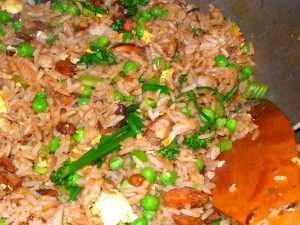
Auckland’s Asian influence didn’t really get going until the 90’s, so it didn’t really figure into the food of my childhood-  my mother like most professional chefs of her day  was schooled in all things classically European, or more specifically, French.   Asian didn’t get a look-in.   One of the few exceptions to this was her excellent, if somewhat bastardised, fried rice. This was one of my favourite meals – still is I suppose – and I always rather assumed that, like wiener schnitzel and spaghetti bolognaise, it featured in the culinary repertoire of most kiwi homes.

Homemade fried rice is often thought of as a leftovers dish – basically an amalgam of whatever pale and flaccid surplus happens to be lurking in the back of your fridge.   I don’t agree with this at all, particularly in regards to vegetables, which should always be super-fresh and crunchy.

On the subject of fried rice, many recipes issue dire warnings about the importance of starting with completely cold cooked rice.  Failing to take heed will apparently result in a disastrous stodgy mess and probably lead to your eventual shame-related death.  This may be true of some lesser rices, but I’ve found that both jasmine and basmati (my two favourite rices – and in that order too) can be tossed into the pan, piping hot, without so much a hint of stodge or a blushing demise.

Virgil’s Fried Rice

2 cups cooked jasmine rice – hot or cold

3 eggs

1 onion- finely chopped

4 cloves garlic- crushed

1 cup frozen peas

½ cup mushrooms – finely chopped

1 cup finely chopped fresh vegetables of your choice ( e.g celery, broccoli, bok choy, spring onions)

1 cup finely chopped marinated * meat of your choice (e.g. chicken, beef, pork)

3 tablespoons dark soy sauce

1 tablespoon five-spice powder

1 tablespoon dark sesame oil

 1 teaspoon rice vinegar

Peanut oil for frying

Roughly whisk together the eggs with a pinch of salt.  Lightly brown on both sides in a smoking-hot, oiled pan.  Set aside and coarsely shred when cool.

In separate batches flash-fry vegetables (not the peas) and mushrooms then set aside. If including meat stir-fry until cooked and all marinade has been absorbed/evaporated. Set aside.

Using a well-oiled deep pan or wok, sauté the onion and garlic until lightly browned.  Add the rice and, using gentle movements, fold together with the onion.  Add the soy, sesame oil, five spice and vinegar and continue folding until the rice is evenly coloured.  Now add all remaining ingredients.  If using peas directly from freezer (I usually do) allow rice to rest for 5 minutes+ before serving.  Season to taste.

I serve this with chilli oil and rice vinegar or lime juice

 *Basic meat marinade

4 tablespoons dark soy sauce

3 tablespoons brown sugar

3 cloves of garlic- crushed

1 teaspoon fresh crushed ginger

1 tablespoon dark sesame oil

1 pinch 5 spice powder


I don’t know anyone who dislikes fried-rice, but presumably they’re out there somewhere.   But I do still wonder – do other people think of fried rice as a home-cooked classic?

And if so, care to share?

The Very Good Oil

Virgil Evetts

Since my recent foray into deep-frying, I’ve been giving a lot of thought to the many oils we use in the kitchen. At any one time I have at least 4 or 5 different types of oil in the pantry, and use them all in different ways and for different reasons. It’s taken me years to work out what oil works where – and although it’s largely matter of taste, there are a few guidelines that are best adhered to in terms of oil appropriateness. Strangely, considering how widely and frequently we use oils in our cooking (probably every night for most of us), it’s not something often discussed. Modern food books seem to mostly to be in the pocket of the olive oligarchs (as evidenced by the frivolous over-prescribing of extra virgin olive oil for everything from pesto to pad Thai,) or worse still they demand the use of a mythical substance called ‘vegetable oil’.

So it seems to me that a brief guide to the best and brightest of edible oils – at least as I see them – might be timely. I’m not going to delve in into the dull complexities of nutrition in any detail, except to say that vegetable oils are fats – albeit of a slightly gentler kind than animal fat – but if taken in quantity will generously deliver on the promises of that name. Do you really need me to expand upon this? It’s been said by some – far too often, If you ask me – that the secret to a long and happy life is to take everything in moderation. Makes sense, I suppose, but the history of popular culture is littered with contradictory evidence that the secret to a brief and bloody fabulous life is to indulge in everything to catastrophic excess – think Cass Elliot, Elvis Presley etc. I’m not about to tell you which way is better. It’s your trip.

Culinary oils fall into two main categories – the ones we use for actual cooking (frying, deep-frying, bastings etc) and the ones we use ‘raw’ for dressings, dips, sauces and marinades. Some, like peanut oil, can serve both functions; whereas others should never rise above their stations. (For example, dark sesame oil, which would be a very odd, not to mention expensive, choice for deep-frying; although I’m sure it’s only a matter of time before Heston Blumenthal gives it a whirl! )

There are a great many more oils available to the keen cook than those listed below; these are just the ones I know best.

Olive

Considering the word ‘oil’ is derived from oleum – the Latin for olive oil – it seems appropriate to start here.

A number of different grades of olive oil are available, but as far as I’m concerned extra virgin is the only one worth talking about.

Pomace olive oil – should you have the misfortune to come across it – is a barley food grade abomination extracted with detergents from pre-squeezed olive dregs. It’s nasty stuff and will again never pass my lips. As for light olive oil – what’s the point?

Extra Virgin Olive Oil

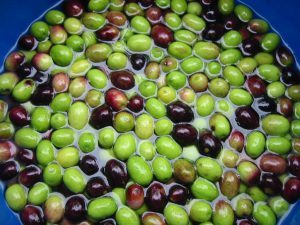
By definition extra virgin is any oil resulting from the first pressing of the olive mash, which is stirred and re-pressed several times to obtain successive grades of oil. It’s often vibrantly green, almost syrupy, with a strong herbaceous fragrance and slightly acrid tang. If you only know extra virgin olive oil by way of those blockbuster supermarket brands, my description may seem a little OTT, so allow me to explain: although allegedly within the required parameters of acidity, body and colour to be classed as extra virgin olive oil, the vast majority of oils sold under that name in supermarkets are worlds apart from the best of their kind. Its long been rumoured that various parties abroad are telling greasy little porkies, because the apparent annual extra virgin olive oil yield of Europe is impossibly high – there just aren’t enough trees  in Europe today to be making the volume of extra virgin oil sold under that title. Accusations of adulteration and tampering are thrown around from time to time, but are quickly silenced by the all-powerful and powerfully litigious International Olive Council. Based in Spain, this uber- bureaucratic cartel is alarmingly influential and highly secretive – rather like an oilier version of Opus Dei.

The fact is, if you’re paying around $10-$12 per litre for so-called extra virgin oil, you will be getting oil that is excellent for frying and maybe the odd salad dressing – but that’s about it. However, as long as you don’t believe a word of the faux-talian marketing spin, its great stuff. Supermarket extra virgin is my preferred oil for everyday use, and I go though around a litre per week. It may not be anything special but it makes a damn fine kitchen workhorse.

True extra virgin oil, by contrast is wasted in the pan. It may be THE oil for drizzling over bruschetta, or insalata Caprese, and for making the finest vinaigrette , mayonnaise and aioli but never for cooking. It’s best thought of as a condiment oil. To be enjoyed at its best, extra virgin oil should be very fresh, preferably no more than 6-9 months old) and have been stored in darkness (UV light destroys the delicate flavour and colour).

The New Zealand olive industry is going from strength to strength, and our oils have won many international accolades. These home-grown EVO’s represent excellent value for money, when compared to their high end counterparts imported from Tuscany and beyond. In fact, the best local olive oils are generally superior to any of the imported equivalents I’ve tasted, and better than many I’ve tasted overseas. This is something to be proud of. Better still, along with our growing reputation for producing world class wines, it annoys the hell out of the Europeans!

There is no great art to choosing a premium olive oil – but always try before you buy. Quality can vary hugely from year to year, and is dependent on freshness and correct storage. In other words, don’t assume that what was breathtaking last year will be quite so incapacitating this time around.

Peanut A.K.A Groundnut oil

A much-maligned oil on account of its pedestrian progenitor, high saturated fat content and potential for purging the world of people with nut allergies with all the swiftness of sarin in the Tokyo tube network. But to hell with that; peanut is the only oil to use for Asian style stir fried cooking. Simply nothing else will do. It has a warm, peanuty aroma and similarly pleasing taste, which blends so beautifully with the salty-sweet flavours of many Chinese creations. There are few finer scents of the kitchen that that of onions sizzling in smoking-hot peanut oil.

Apart these obvious applications, peanut oil also turns up in a few unexpected places – most startlingly in Julia Child’s classic crepe batter recipe from her magnum opus Mastering the Art of French Cooking. I too was sceptical at first, being far more used to liberal lashing of butter, but now wouldn’t do it any other way. Side by side with olive oil this stuff deserves a permanent place by your stove.

Sunflower

Rather as the name suggests, pressed from oil-rich sunflower seeds. I like this oil for its very clean, slightly sweet taste. Although I rarely cook with it myself, it is a very decent oil for frying, but is even better suited to more subtle applications. I personally find mayonnaise made with pure EVO too strongly flavoured – too olivey to be exact – so instead use 2 parts sunflower to 1 part olive. The resulting mayo is still rich and eggy, but has a little more finesse than the usual uber-olive slap in the face.

Sunflower oil works particularly well for preserving sundried tomatoes and other vegetables in the Italian style of sotto oleo (under oil). Made in the traditional way – with olive oil – any subtleties of the produce are lost under a screaming excess of olive. So, once again, a 2-1 dilution works very well to my taste. (It’s easy to get carried away with the romance of preserving things in oil; it seems so very easy and the results look almost better than they taste, which is seriously saying something. But be aware that it’s also a potentially lethal practise, which in the wrong hands can lead to botulism poisoning and ergo a whole world of unpleasantness. So for the love of Vishnu, do your homework first. A very good place to start is by reading Preserving the Italian way. This extraordinary book remains the only authentic English language-guide to traditional Italian preserving methods, covering everything from jams and pickles to salami and hams. It’s a wonderful read and deserves prime real estate on any serious Food Lovers bookshelf.)

Grape seed

Disappointingly for most newcomers to grape seed oil, it doesn’t taste even remotely of grapes. Actually it doesn’t really taste of anything at all, but this quality, coupled with a very high burning point, is what makes grape seed oil one of the unsung heroes of the modern kitchen. This is the oil to use when you don’t want your food to taste oily. It has a remarkably light mouth-feel and squeaky- clean finish, making it is equally well placed in salad dressing or the frying pan. Grape seed oil is a relatively new product – as in the last few decades – and is unsurprisingly a by-product of the wine industry. It has a reputation for being one the finest oils for deep-frying, but is (at least according to my finances) a tad too pricey for this extravagance. If you can afford such lavish fry-ups, then by all means go crazy.

Canola

If you’ve ever wondered what exotic plant, nut or seed yields canola oil you’re in for a bit of disappointment. Canola is simply the patented name for a couple of strains of rape (a type of mustard). The word is a hybrid anagram for Canadian Oil Low Acidity and, as you might have guessed, it was first developed in Canada. Canola has that classic cooking oil aroma, and although too coarse for salad dressings or mayo is well suited to deep-frying, as it lacks the heavy, lingering odour that is typical of other low-cost oils.

The biggest negative associated with Canola is that it is one of the most genetically altered of all food crops (which despite what certain zealots would have you believe is not necessarily a bad thing in itself). What is really worrying is the reason why canola has been so wildly manipulated -to resist herbicides. This means farmers can cheerfully douse their canola crops with what would be, to any other plant, a lethal dose of deadly chemicals, thus saving farmers the costly, laborious effort of manual or mechanical weeding. It also means that the crop has been exposed to an alarming amount of God knows what, which is often detectable and very possibly concentrated in the seed-oil.

Soy

To me soy oil is a bit of last resort. I don’t like the heavy, rank odour it releases when heated and, as with canola, the parent plant has a seriously buggered-up gene pool. However, it does lend itself very well to deep-frying (as long as you have a decent range-hood to suck away that awful chip-shop funk). In case I haven’t said it before, deep-frying really isn’t  something to fear. As long you follow the golden rules of NEVER WALK AWAY, NEVER ABOVE 190 CELSIUS (some oils can be safely heated well above this but it’s a good safe guideline) and NEVER OVER-FILL ( some foods- especially if they are wet – cause much wild bubbling which in too small a pot will over-boil and burn like Hades in a heat-wave). The only limit to how much you can deep-fry is the width of your arteries.

Dark Sesame

Strictly condiment oil and a true must-have for any pantry with a bit of pride. Chinese dark sesame oil is pressed from roasted sesame seeds (unroasted sesame oil is popular in many Middle Eastern countries) and has a wonderfully rich, toasty flavour and that definitively ‘Asian aroma’.

This oil is best added to dishes just before serving – so as to preserve its potent, yet fragile, nature. It’s just dandy with pork and chicken, and has an even greater affinity for cashews and celery, odd as this may sound. Dark sesame oil is also an excellent base for the most exquisite Asian-accented vinaigrette. Shake or whisk together 2 parts dark sesame to 1 part soy sauce, 1 part rice vinegar and good slug of fish sauce. This dressing lifts any salad well beyond the over-blown garnish status, and is especially good with finely shredded, raw Savoy cabbage and a scattering of roasted peanuts.

And finally, the almost rans:

Rice-bran

This was the darling of the health-conscious set not so long ago and, as is consistent with all they hold near and dear, it’s vile stuff. Blessed with a wet-cardboard aroma and highly forgettable flavour, rice-bran oil is best left to those with whose main criterion for food is how well it will regulate their bowels. Tastes better than cod-liver oil I suppose.

Coconut

I tried with all my might to like coconut oil, but the fact is it stinks. Really stinks. The rancid, almost viscous ‘fragrance’ permeated every thread of every soft furnishing in my house, and I was duly banned from ever using it again. But that wasn’t the end of the fetid affair: I tipped the entire economy size bottle down the kitchen sink (with a good glug of detergent and a lot of hot water) and was then haunted by the distant, but undeniable, odour of stale coconut every time I went near a drain in or around my property for weeks.

I’ve since learned that some coconut oils are better than others for cooking and I might, one day pluck up the courage to try again. I’ve seen deodorised coconut oil – a lard-like solidified mass at health-food shops from time to time – but as with ‘lite’ olive oil, I really can’t see the point.

Well that certainly ended up being a more long-winded diatribe than I had in mind, so you’ll be pleased to know I’m done.

But now I want to hear what oils you use, abuse and detest. Come on. Out with it then.


How to use… Dried Shiitake Mushrooms

Virgil Evetts

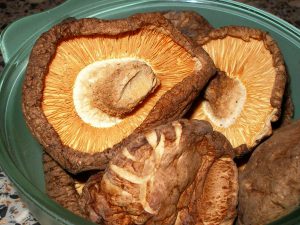
These rather ropey-looking fungi are widely available in most supermarkets, but are the sort of thing that, unless you’ve tried them before, you will probably instinctively ignore.  I can’t say I blame you either – they look like leaf-litter and are hardly shy on the fragrance front.  But take my word for it – these ugly little munters are shrivelled proof of how very deceptive appearances can be.

You see, shiitake are not only a delicious alternative to regular (and let’s face it often boring) cultivated mushrooms, they’re also considered a ‘super-food’ with proven cancer-fighting and anti-viral properties.  I’m normally pretty cynical of such claims, but the virtues of shitake are one of the few topics upon which both Western and Eastern medical practitioners see eye to eye.  So seriously is this cure-all quality taken in Japan that shiitake are available by state-subsidised prescription.

While I do gain a certain smug satisfaction from all this spin, the real attraction for me is simply that shiitake taste really good.  They have a far more robust, earthy flavour than field mushrooms, with a similar meatiness to porcini.  Shiitake offionados actually prefer the dried form of the mushroom to fresh (which are available in some fruit & vege shops) as the drying process improves the flavour. Dried shiitake can be used in practically any Asian recipe requiring mushrooms and can make an often superior substitute for the same in western dishes.

Before you can use dried shiitake they need to be rehydrated. Simply cover with warm water for 30 minutes to an hour, squeeze dry and snip off the tough stems. When reduced, the soaking liquor makes a dark and meaty stock which works very well in soups and fried noodle dishes.

Once soaked, the shiitake can be sliced and used like any other mushroom. They also make a very fine mushroom salad. This is currently my favourite way with shiitake and is quite dangerously more-ish stuff.

Shiitake Salad

2 cups pre-soaked and squeezed shiitake

4 tablespoon dark soy sauce

2 tablespoons rice vinegar

3 teaspoons sesame oil

1 teaspoon chilli oil (optional)

Roughly chop the mushrooms and mix thoroughly with soy, vinegar, and oil. Season to taste.

Doesn’t sound like much, but just you wait…

This salad is a great partner to a decent piece of red meat or a handsome slab of salmon.  Alternatively – and perhaps unexpectedly – it’s freakishly good scattered over a pizza.

Dried shiitake are available at most good supermarkets but are generally far cheaper at Asian supermarkets.

Go out and buy some today.  That’s an order.

Release the dogs…

Virgil Evetts

Since researching and writing about the whole free-range issue a while back I’ve been taking my stance in regards to free-range pork very seriously indeed (I haven’t touched conventionally farmed chicken for years). But as assured as I am of my moral choice (or obligation as I see it), it all gets a bit no-fun, spoil-sport sometimes. Shunning Hong Kong-style BBQ and roast pork from Passion Food, (one of the many outlets in the excellent Rialto car park food hall in Auckland), is a constant struggle. So when I was overcome with a sudden yearning for American hot dogs the other day, I was quite prepared to push it down to that increasingly well-stocked part of my mind reserved for ‘things I’m not allowed to take pleasure from anymore’.

But fortunately, before I put the dogs to bed entirely, I thought to poke around a bit on the mostly un-trusty interma-net, and discovered to my copious salivatory delight that Harmony Meats, the much lauded free-range outfit, produce all natural, free-range pork frankfurters.

Oh happy day!

Another few clicks took me to an online organics supplier, who not only stocks said ethically permissible small goods, but guarantees same-day deliveries.

And so that very night I was able to enjoy what was hands-down the best rendition of the American hot dog ever to pass my lips. And I mean they actually tasted really, really good, and not just from the piquancy of smugness!

These free-range franks have a firm meaty texture and a delicately spiced yet rich smoky flavour. They are a different and entirely superior beats to those red-skinned obscenities you know so well, (yes, the very same ones I have waxed lyrical about previously). They are the perfect foil for the grain mustard béchamel and caramelised onions I use to dress my dogs. Ok, so they aren’t exactly an economy option, but that’s hardly unusual, or unreasonable for that matter, with free-range products. What is a pleasant point of difference is the effort Harmony has made to make these franks a serious step up from their mass-produced supermarket counterparts. They positively reek of quality.

Pictured above is a hastily (and hungrily) shot glimpse of the finished product. A careful observer may notice that those distinctive tartan plates have shown up rather a lot in my articles and blogs of late. They’re an old Crown Lyn design called Tam O’Shanter, and my best beloved is besotted with the stuff. She has single-handedly inflated its value beyond all reason through her violent Trademe bidding wars. Anyway, I will get around to digging out some less obvious prop cutlery from the rarely visited back-of-the-pantry region eventually.

Instead of repeating myself with instructions for my personal version of Hot Dog heaven, do me a favour and click here. I’ve said it all before – just ignore my shameful promotion of tortured pig products .

My ( Formerly) Secret Shame

Virgil Evetts

As much as I might convince myself that I have sophisticated, urbane tastes, embarrassing, childish regression keeps bubbling to the surface. Perhaps I should explain…

 I just can’t help it, I really can’t but I’ve developed a serious weakness for pink hundreds and thousands biscuits. How can this be? They’re horrible- well they should be – but I can’t stop buying and devouring them by the packet-load.

And I might as well come clean – this isn’t the only very-bad-food–indeed obsession I’ve been through and I fear it won’t be the last. First there was the Pringles and wine gums phase, then the milk bottles and glow-heart (sweets) period, cheese flavoured crackers, sherbet dabs, M&Ms, raspberry liquorice straps…

 I’m pretty sure it’s a nostalgia thing tied up with childhood denial or something, but I’m 33 for crying out loud!

Please say I’m not alone in my cringe-food fetishes. Name your shame…


Slow Cooking Low-Down

Virgil Evetts

The thought of deep, earthy slow cooked food is so very appealing amidst the miserable chill of winter. Tough but tasty cuts of meat cooked until meltingly soft, swimming in rich complex gravies along with sweet nuggets of onion, carrot, parsnip and mushroom. If there is indeed any sort of upside to the misery of the cold months, it’s food like this.

Trouble is, most of us lead such crazy, hectic lives nowadays that this kind of cooking is either overlooked or roundly dismissed. Long hours every day spent in the bill-paying grind and then for many of us the tedious (and in Auckland often terrifying) trip home.

Thankfully though, the ever resourceful appliance peddlers have more than a few toys for hungry, weary travellers like us. Bench top slow cookers – rather like bread makers- are a modern kitchen phenomenon. Rather than being just another gimmick and object of clutter, they actually make life easier- which is the whole idea of technology after all.

Slow cookers don’t really do anything that can’t be achieved in a casserole or tajine, but- and I think this is their biggest selling point- they have timers- meaning you can do your prep and then set the cooker to have dinner ready for the table when you walk in the door at night. Kind of like a plug-in 1950s housewife but without the gingham and Tupperware.

As I said, you can do all of this with an oven, but personally I’m always anxious about leaving my oven switched on and unattended. Who knows what it might get up to? Most slow cookers are packed with safety feature which help to minimise the risk of coming home to smoking ruins.

Slow cooking- stews- hot-pots, casseroles and myriad others are common to all cuisines and hark back to the days when most home cooking was done in heavy clay or cast iron pots over an open fire or better still in the glowing embers. This softly, softly approach to cooking renders the toughest cut of meat succulent and tender, brings out the natural sweetness in root vegetables and concentrates flavours to a depth and clarity that is quite simply ambrosial

Gravy beef, chuck steak, blade steak and other economy cuts are the only way to go in the world of bovine based slow cooking. Shanks, neck chops and the off-puttingly named flaps are the sheepish equivalents. I can offer little advice when it comes to slow cooked or stewed pork dishes except to recommend you invest in a good extractor fan first. Rendered pig is more than little a wiffy.

The best vegetables for slow cooking are the cool climate classics- carrots, parsnips, potatoes, celeriac, onions and dare I say, it even Swede. Given time and patience, this most odious and odiferous of roots can be transformed into something quite special. Yes, seriously.

As you might have guessed by now, I’m a bit of an Italio-phyle. Being a bit of milkshake of Maori and European ancestory, I was often mistaken for Italian or some other Mediterranean extraction as a child- which suited me just fine. Although I’ve since learned that masquerading as another ethnicity is a bit sad, I do still have a love for all things Latin- specially things of an edible nature. So it’s probably no surprise that one of my all time favourite slow cooked dishes is osso bucco. This recipe, from Italy’s milk-fed north, uses one of the most under-rated of cuts- veal or beef shins. Although initially startlingly tough- (the shin muscles get quite a work out in life) but when cooked down slowly  in a stew of tomatoes and wine they become fall-apart tender and yield bucket loads of gorgeous bovine depth. Although not to everyone taste, the built-in fount of luscious, creamy marrow in the centre of the bone is just the icing on the cake for me. I could eat that stuff all day or at least until my arteries gummed-up.

I’m a huge fan of parsnip either mashed, as crispy wafer-thin chips but most especially in rich, beefy stews and casseroles. Always referred to as ‘snarpips’ in my family, their silky, sweetness and delicate herbal flavour is the perfect partner to so many of my favourite dishes. Whether they feature in the recipe or not, parsnips can do no wrong- so don’t hold back.

Lamb is often over looked as a stewing meat, but Irish stew; a restrained but hearty dish of lamb meat- neck chops do particularly well here- potatoes, onions and carrots, is easily among my favourite winter offerings. Served with soda bread or dumplings it’s a dish of the very deepest satisfaction.

Lamb shanks’ are probably the best know cut of the sheep for the slow cooked treatment, and while not as affordable as other stewing meats, they offer gorgeous buttery, flavoursome meat and a wonderfully lamby stock.

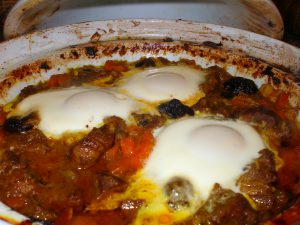
Lamb shanks’ work particularly well in a tajine- and can replace the rump specified in this recipe quite admirably. I probably make more tajines in winter than any other kind of slow cooked dish. There are literally hundreds of variations on the tajine- (which is in fact a cooking vessel, but much like the casserole is most often used to describe dish itself), but they all follow a similar pattern. Tajines are usually meat based (lamb, duck, kofta, beef, goat), contain basic vegetables such as carrot and onion and are flavoured with typically North African spices like cinnamon, cloves, turmeric and saffron. The inclusion of dried fruits such as apricots, prunes, fig and quince is a hallmark of tajine cooking as is the addition of various nuts. Many tajine recipes also include honey, which while quite traditional can be a bit alarming to the western palate when added too liberally. On the other hand, I very much appreciate the Moroccan habit of breaking an egg per diner into the tajine shortly before serving (pictured).

And before you’re wooed by the wares of Milly’s et al, no you don’t need an actual tajine (the conical lidded cooking vessel) to make a tajine stew- they work equally well in a casserole or electric slow cooker.

If I was the whiney, pleading type and hell, maybe I am, I’d be pushing you towards tajines more than any other style of cooking this winter. They’re perfect for lazy cooks because you don’t need to brown anything, making them the archetypal one pot wonder and I’ve yet to find a person who doesn’t visibly swoon when the lid comes off.

I’m of the opinion that chicken is usually wasted in stews, casseroles and even tajines. The flesh disintegrates into pappy fibres and I’m often left wondering how I can dispose of the whole mess without the host noticing (Labradors are very useful here). However, there are one or two very passable chicken stews and similar, of which my favourite by far is coq au vin. Not a million miles from Beef Bourguignon (another Grande Dame of the French cooking repertoire) coq au vin – meaning rooster in wine- consists of chicken portions slowly cooked in red wine with onions, mushrooms, bacon and the classic bouquet garni. Older recipe specify an actual rooster for this dish along with its blood. Anyone who’s spent much time in the proximity of a rooster may find this rather appealing.

Once you’re in the habit of making tajines, stews, casseroles and other slow cooked pleasures of the cold months, the style becomes quite addictive. I’ve even been known to stretch out my tajine season well into summer. After all, it gets hot in Morocco, right?

In these rather worrying days of crumbling economies it’s a pleasure and relief to find recipes that are affordable, nutritious and thoroughly delicious. This is certainly true all of the above and most slow cooked dishes for that matter. So if you’re not a slow cooking convert just yet- get thee to the crock pot!

Mere Macaroni

Virgil Evetts

For one reason or another- but mostly because of the criminally high prices of dairy in recent years, good old macaroni-cheese- that most kiwi-fied of dishes had completely dropped off my cooking radar. In fact I’d pretty much forgotten it existed, when out of the blue just the other day, it popped into my head. Then nothing else would do for dinner.

I think macaroni is probably one of those dishes that everyone had as a child but everyone had a slightly different version. I’m coming to really appreciate these family specific food traditions. We may not have a true food culture in our infant nation but we do have a few established classics- macaroni-cheese, spag- bol (quite distinct from, but just as noble a dish as it ancestor- ragu alla Bolognese), curried a sausage etc.

As ubiquitous as these dishes may be to our kitsch kitchen vernacular, every cook makes them with a unique familial flourish. And yes I know, that in the past I’ve been guilty of a degree of snobbery about such cooking- ok quite lot of snobbery actually ( e.g.’ provincial, pedestrian, pap…’), but I’m starting to see these as the classic and very legitimate examples of real New Zealand cooking- circa late 20th century that they are. They are spin-offs from various political ups and downs of their time and place- post WW2 Italian emigration to Australia and (to a much lesser degree) New Zealand, the last gasp of colonial India…

All fascinating stuff, and worth a thesis or two no doubt, but for now- back to my macaroni. Naturally I make macaroni as I was taught to do, which I’m willing to bet is a little different to how you were taught. Not better, nor worse just different. Such is the nature of these local treasures.


Evetts Family Macaroni Cheese

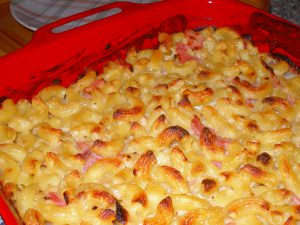
In a little oil sauté 1 finely chopped onion, 4 or 5 cloves of garlic (crushed) and a few sprigs of thyme (de-stemmed) until lightly browned. Set aside. Make a béchamel with a couple of tablespoons of butter, about the same of flour and 1 ½ cups of warm milk. Whisk until thick. Add a cup or 2 of grated tasty cheddar, ½ cup white wine, a couple of slices of roughly torn free-range ham and the onion/garlic/thyme mixture. Stir until thick and smooth. Season to taste. Fold in a packet of cooked macaroni, ladle into a baking dish and grill until golden and crispy on top.Serve with a crisp green salad and a generous glass or two of something dry and white.


Despite my earlier fiscal misgivings, this dish is quite economical to make and a pretty straight forward week-night endeavour.

This is the sort of cooking to pass on to your children. My recipe heirlooms are far more precious to me than any objet d’art, but I guess I’m weird like that.


So- how do you make your macaroni and what are your family food heirlooms?

Churros up

Virgil Evetts

I am so in love with Churros right now. As promised in my posting on cannolli, I set about making them on the weekend, and I gotta say- OH MY GOD.

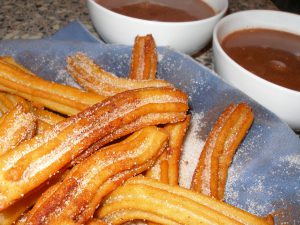
I used the recipe from the excellent Movida cook book. Movida is a truly outstanding tapas bar/Spanish restaurant in Melbourne (with two branches), run by Frank Camorra, the God father of Spanish cooking down-under. And churros , for the sake of those of you who have thus far been denied their very decadent delights, are an extruded Spanish doughnut. They are little fingers (rather than rings or balls) with characteristically fluted edges, which help to catch the thick, almost malevolently rich hot chocolate with which they are traditionally served.

Unlike many doughnuts they are not made with a yeast dough. Churros dough consists of nothing more than flour, baking powder, boiling water and oil. Why boiling water, I do not know but I’m not about to question it.

Traditionally the dough is squeezed through a heavy duty syringe-like device called a churrera. After doing this job with a piping bag I can see why- the dough is very, very stiff. That part wasn’t fun and next time I’ll definitely be using a cookie press or something similar. Once extruded the little fingers of dough are deep fried at about 170 C until perfectly golden, then drained and dusted with cinnamon sugar.

My home-made churros where pretty damn close to the crispy, sugary perfection I first tried at Movida several years ago. Obviously I can’t publish the actual recipe here, but the net is clogged with churros recipes if you bother to look, and Movida is a fine addition to any home library.

To make the hot chocolate I whisked together 3/4 cup of hot milk with ½ cup of cream, 1 teaspoon of pure vanilla essence, about 200 grams of dark chocolate and a shot of Cointreau.

This is powerful stuff and a little goes a long way. Theoretically.

I went to bed very happy that night.

Chocolate guilt

Virgil Evetts

When you start to unravel the ethics of eating, it rapidly becomes impossible to exist with a clean conscience.

Take chocolate for example – amazing stuff, I love it to bits. But the closer you look, the more problematic its very existence is to anyone with a bit moral fibre. 

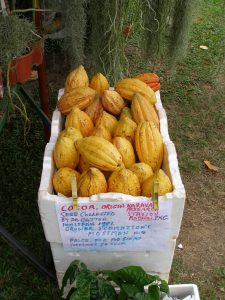
Before we get anywhere near the evils of palm oil, we have to look at cocoa itself. The cocoa tree is what is known botanically as an ultra-tropical species – this means that it simply cannot grow outside of the tropics without seriously impractical assistance. Worse still, it’s a rainforest tree, requiring the high humidity and relatively poor soils of its natural habitat – the Amazon basin… you see where I’m going here?

Now just imagine how many cocoa trees are needed to keep the entire planet supplied with chocolate. Millions upon millions of trees. And for each and every one, a little patch of rainforest has been obliterated – trees, monkeys, bugs and bacteria. All gone.  Now because cocoa is a commodity, its prices are constantly fluctuating. When the value drops, farmers abandon the trees and move on. When the prices rise, they cut down more forest and start again.

And then (as another Foodlover pointed out), there is the sugar. Ever visited the cane fields of Northern Queensland? Thousands of hectares of once-lush lowland rainforest wiped clean.  At least Australia has environmental protection laws. Most sugar, cocoa, coffee, vanilla and other delicacies we hold near and dear are grown in countries where the environment is treated like a latrine.

And as for palm oil… well frankly, Cadbury are just the tip of the iceberg. This stuff has quietly snuck into a vast array of foods, cosmetics and many quite unlikely places over the past several decades. I too am mightily pissed off with Cadbury for adding it to their chocolate-like products, but only because companies of their size usually make superficial efforts to appear environmentally responsible. Trying to boycott palm oil is like trying to boycott soy protein or carob gum – it’s in practically everything, so good luck!

So my point is, I no longer know whether I shop ethically or just smugly. For every evil I avoid, there are a hundred other things I tacitly support that are slowly tearing the world apart.


How am I supposed to enjoy anything anymore?

Pasta the poverty line

Virgil Evetts
I’ve been thinking about the term ‘peasant food’ lately. It’s become such a clichéd part of the western food lexicon. We use it to describe anything vaguely rustic and it makes us think of crumbling Tuscan farm houses, wood fired ovens and good-natured, salt of the earth country folk. Can’t you just smell that spit roast lamb? Yes, well it’s also deeply patronising. Describing the culinary traditions of rural Europe as peasant-like is about as flattering as calling African American culture slave-like.
I think the only reason most Europeans don’t noisily object is that they know they’re on to a good thing. Ignorance may breed bigotry, but it also breeds rampant stupidity. The attraction of living in a restored farm house is a complete mystery to most Italians. Why would you want to live in a crumbling old dump that has no indoor plumbing and is full of snakes and scorpions? Who cares, if you’re willing to pay a million Euros for it.

But that’s not to say that there isn’t genuinely humble country cooking in Italy and the rest of Europe. Many of my favourite dishes would be described in Italian as cucina la povero. This literally translates as cuisine of the poor, but is meant to be complementary rather than chin-ticklingly patronising. The logic being that cash-strapped folk can work miracles with very few ingredients. I think this is a truth that extends (or at least, used to) well beyond the borders Italy.  We were as poor as particularly down-trodden church mice when I was growing up, but we still ate very, very well every night. But then, I had the good fortune to be to be born into a family that cared deeply about food- more so than each other in some cases. Thanks to the fungoid spread of convenience foods and cheap takeaways, whole generations are now missing out on learning to cook. Jamie Oliver’s School Dinners anyone? I rather fear that that the modern New Zealand equivalent of cucina la povero would either come from a box in the supermarket freezer or via a drive through window.

But I digress; I was talking things Italian…

If you paid too much attention to the advertising campaign of a certain pasta sauce company (the one with the horribly stereotyped puppets) you would think that Italians always smother their pasta (which is the only food Italians eat according to these puppets) in rich tomato, cheese or meat-based sauces. This is hyperbolic at best, and the further south you go in Italy, the more wildly inaccurate it becomes. The harsh climate and poor soil of southern Italy has traditionally made meat, dairy and even tomatoes luxury items. Sure, they still eat plenty of pasta down Napoli way, but it’s often dressed far more frugally than in the relatively affluent north. Gone (or at least less common) here are the Bolognese and Carbonara, replaced instead with simpler but deeply satiating dressings of good quality olive oil, garlic, chillies, perhaps a scattering of salami or pancetta and some seasonal greens. These sorts of dishes are designed to be made in a flash, by anyone – be they a lone shepherd high in the myrtle scrub or an urban mamma with a gang of hungry mouths to feed in a Neapolitan housing project.

Ask a southern Italian what their favourite pasta dish is and they will probably tell you fettuccine al aglio e olio or something very similar. This is just about the simplest recipe imaginable, containing, in its purest form nothing more than garlic (LOTS of garlic), olive oil and seasoning. With deft execution, this is about as good as eating gets. It confounds the taste buds every time. How can something so simple be so damn good?

This, and myriad other oil-based pasta dishes, are classics of Southern Italian cooking. Despite their simplicity they offer some of the best eating of Italy’s vast and varied cuisines.  The ingredients of this family of dishes are either fried or steamed quickly before being tossed together with cooked pasta. There are some established classics such as fettuccine al aglio e olio, which save for a few regional variations, are made according to strict tradition. But, as with fried rice in many Asian cuisines, you can add whatever you have at hand. Just use your best judgement and good taste to match flavours and textures.

Oil-based pasta dishes are best made with shells, orecchiette, spirals or in some cases flat noodles such as fettuccine. These shapes snare plenty of delicious little nuggets of garlic, chilli and other tasty things. Avoid macaroni, penne, and other tubular pasta – these are designed for very wet sauces and won’t work so well here.  I have an irrational aversion to bow-tie pasta (Farfalle). Perhaps it’s because I once worked for a man who wore actual bow ties everyday as his signature dress thing. How I loathed those bow ties…

Anyway – here are a few recipes that are on a regular turn around at my place. As is typical of this sort of dish, they’re quick and easy to make – being far more about assembly than actual cooking – and are an affordable way to feed a crowd. In my experience all of these recipes go down well with kids too, which is always a bonus.

Fusilli con Broccoletti
(Spiral pasta with broccoli)

1 head of broccoli (chopped into small florets)
6+ cloves garlic, peeled and crushed
Fresh or dried chilli to taste (crushed)
1 cup black olives (preferably Kalamatta)
4 strips free range bacon (roughly chopped)
½ cup slivered almonds (toasted)
3 tomatoes (deseeded and roughly chopped)
½ cup extra virgin olive oil
1 large packet Fusilli (spirals)

In a dry pan sauté the bacon until crisp. Drain on kitchen paper.
In a deep pan/wok heat the olive oil. Add garlic and chilli, stir until fragrant. Remove from heat. Do not allow to brown.
Bring a large pot of well salted water to boil. Before adding the pasta use this water to either steam of blanch the broccoli- it should still be vibrantly green and slightly crunchy.
Cook and drain the pasta. Return the oil to the heat and add the pasta. Fold in all other ingredients, season to taste .
Serve immediately with a little shaved parmesan, pecorino or fried bread crumbs (recipe below)

Fettuccine al aglio e olio
(Fettuccine with garlic and olive oil)

10+ cloves garlic (crushed)
Chilli to taste (crushed)
½ cup olive

Optional:
Black olives
Capers
3+ Anchovies (finely chopped)
Fresh parsley (finely chopped)
1 large packet fettuccine

In a deep pan/wok heat the olive oil. Add garlic and chilli and anchovies, stir until fragrant. Remove from heat- do not allow to brown. Cook and drain the pasta. Return oil to the heat and add pasta. Fold in any other ingredients, season to taste and remove from heat.
Serve immediately with a little shaved parmesan, pecorino or fried bread crumbs (recipe below)

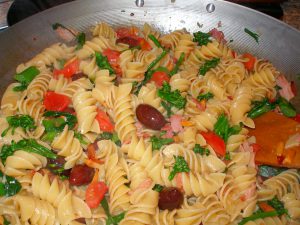
Chorizo, garlic and other good things with spiral pasta

This is a dish entirely of my own creation. It’s a good example of how well this style of pasta lends itself to improvisation.

6+ cloves garlic
250 grams chorizo or similar cured spicy sausage (sliced)
1 cup black olives (preferably Kalamatta)
Fresh or dried chilli to taste (crushed)
3 tomatoes (deseeded and roughly chopped) OR 2 red peppers, char-grilled, deseeded, peeled and roughly chopped.
Big handful of fresh basil OR fresh rocket
¼ cup toasted pine nuts/pistachios/slivered almonds
½ cup olive oil
1 large packet Fusilli (spirals)

In a dry pan sauté the sausage until fragrant and crispy. Drain on kitchen paper.
In a deep pan/wok heat the olive oil. Add garlic and chilli, stir until fragrant. Remove from heat- do not allow to brown.
Cook and drain pasta.
Return oil to the heat and add pasta. Fold in other ingredients, season to taste and remove from heat. Serve immediately with a little shaved parmesan, pecorino or fried bread crumbs (recipe below)

Fried bread crumbs

In the past, few southern Italians could afford expensive hard cheeses such as pecorino and parmesan, so to dress their pasta, they came up with this quite passable alternative. These bread crumbs bring a very pleasing crunch and a deliciously salty, toasty tang to each mouthful of silky pasta. They’re also a doddle to make. Roughly zap a few slices of good quality stale bread in a food processor. Heat a generous amount of olive oil in a pan, add the bread crumbs. Stir until dark golden-brown and super crunchy. Don’t be stingy with the salt, these need plenty- blood pressure, be damned.
Drain on kitchen paper or a tea towel.

So whether you’re poor or flush, why not give these recipes a whirl? If this sort of food is anything to go by (and in reality it probably isn’t) poor Italians must eat a damn site better than your average financially buoyant kiwi, don’t you think?

Can I Cannoli?

Virgil Evetts

I’m a bit lily-livered when it comes to deep-frying. I used to own a bench-top deep fryer, which makes the process pretty fool [ergo flame] proof, but I got sick of cleaning the perpetually greasy thing and hated the smell of stale oil that hung around the house after every use.  So it was eventually sentenced to death,  via the inorganic collection, labelled ‘works but very unpleasant’. This was no doubt a good move for my waist, which isn’t quite as waspishly thin as it once was, but I do sometimes pine for a deep-fried treat or two. I’ve had a particular hankering lately for cannoli. These exquisite Italian pastries are almost unknown in New Zealand, which in my weaker moments is enough to make me consider emigration. Just recently I’ve been feeling very weak indeed, but apparently the Italian government doesn’t recognise pastry deprivation as grounds for refugee status.

 So armed with a deep-frying thermometer and a couple of litres of oil, I’ve been doing my best to conquer my fear of stove top deep-frying and to get my head around cannoli making- with some rather tasty results.

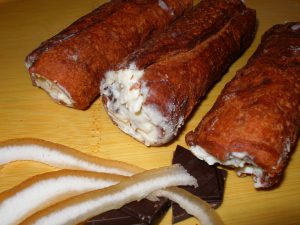
Cannoli, if you haven’t yet had the pleasure of making their acquaintance  are a delicious blend of naughty and nice-  crunchy deep fried pastry shells filled with a seemingly rich but really quite healthy blend of  ricotta, bittersweet chocolate chips and good quality glace peel. They may not sound like all that, but there is a reason why cannoli, once a strictly Sicilian specialty are now just about the most popular pastry in all of Italy. They’re very, very good.

Cannoli pastry is bit weird- it contains unusual ingredients like wine and vinegar, but it’s really a doddle to make- far more forgiving than most of its kind, and is sure to please even those obnoxious types who piously claim to lack a sweet tooth. Whatever.

My recipe is the result of a fair bit of trial and error. It works and I like it, which are the only criteria I really care about.

Most Italian recipes stipulate a lot more sugar in the filling than I’ve suggested here and they also have a tendency to include various nuts, glace cherries and other things jewelled and sickly. It’s a point of personal taste really but I prefer to take a simpler, less cloying approach.

You will need some sort of form to hold the pastry while it fries. In Italy, proper metal cannoli forms are available. I’ve made do with a wooden broom handle cut into roughly 10cm lengths.

Cannoli

Makes about 6

Pastry

1 ½ cups plain flour

2 tablespoon butter

2 tablespoons sugar

2 tablespoons cocoa

1 egg

1 teaspoon red wine vinegar

2-3 tablespoons dessert wine, Marsala or Port

Pinch of salt

Vegetable oil [not olive or peanut] for deep frying.

 Filling

500 grams ricotta

¼ cup caster sugar

½ cup coarsely chopped glace peel

½ cup bittersweet/dark chocolate chips

1 tsp pure vanilla essence


For the pastry

Mix the wet ingredients [use an electric mixer if you have one] into the dry and work into a firm, slightly elastic dough. If too dry and crumbly add a little extra wine, if too wet add more flour. Roll into a ball, cover with cling film and rest in the fridge for around an hour.

Pre heat the oil to about 170 Celsius.

On a smooth, lightly floured surface, roll out the dough to a thickness of about 5mm. Cut into strips the width of your forms. Roll the pastry around the forms and cut at the joint. Seal the joint with a little water or egg white. Carefully lower the pastry/forms into the hot oil in batches of 2 or three. Fry for about 2 minutes each, turning the forms to ensure the pastry is evenly cooked. Remove and drain on kitchen paper. Once cooled carefully slide the pastry shells from the forms. You may need to use a paring knife to help with this.

For the filling

Use a fork to lightly whip the sugar into the ricotta. Gently fold in the chocolate and fruit. Use either a piping bag with a wide nozzle or a small teaspoon to firmly fill the cooled pastry shells.

Serve  with coffee, grappa or just on their own when no one’s about. They make a very fine breakfast too.


So that’s my deep-fried weakness [enough to make me risk stove top immolation] what’s yours?

Won tons? Deep-fried camembert? A nice plate of chips?

Name your poison.

Lemon-licious

Virgil Evetts

It’s true that the food garden is a mostly lifeless, dreary, place in winter, but a little sunshine can be found in the form of citrus. While I sometime curse the lack of local limes and their kin in the sweltering heat of summer, they are still most welcome when they do turn out- through these bleakest months of the year.

In my garden I have an unfeasible number of citrus trees which reflects my love of the fruit and my complete lack of self control in the backyard.

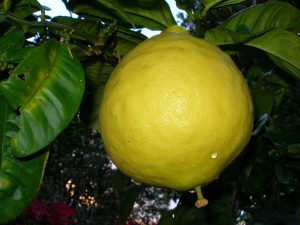
At present I have a moro blood-orange, an etrog citron, a Tahitian lime, a Key lime, a kaffir lime, a mandarin, a yen-ben lemon and finally my fruit of the moment- a  magnificent and benevolent ponderosa lemon.

This mammoth fruit- probably a cross between a lemon and a citron was once the lemon of choice for the kiwi backyard, but was superseded in the 60s and 70s by smaller fruited, hardier varieties such as yen-ben and the indestructible but rather blah meyer , an orange-lemon hybrid.

And what a shame that is. The ponderosa may not produce as many fruit as newer breeds but it pays its way with the staggering size of its fruit [easily over 1 kilo each], copious volumes of sharp, tangy juice and the heady fragrance of its zest.

The ponderosa is also among the most ornamental of citrus, with an open growth habit and those oversized, improbably yellow fruit- which last for as long for as you can resist picking them.

The ponderosa is a bit of a twofer fruit [as in two for one]. The juice – nearly a cup full per fruit-can be frozen for use throughout the year and the thick, swooningly fragrant rind makes the best glace peel I’ve ever tasted.

Due to it’s decidedly boutique status, the ponderosa is very hard to get hold of. The only suppliers I’m aware of in New Zealand are Russell Fransham Subtropicals. Russell’s a really nice guy  who knows his plants, delivers nationwide and his catalogue is well worth a peruse.

So…

Is anyone else out there growing a ponderosa?

Do you have a favourite backyard citrus variety?

Had enough freeby grapefruit yet?

Am I the only person who gets a slightly fetishistic buzz out of smelling my fingers after handling limes?

And if that’s not enough for you,  here is a link to a pretty little  [sort of] lemon-themed song by the fabulous Dory Previn. As a child I interpreted the chorus very literally- evoking Munch Bunch-esque imagery. I have since realised it’s actually about the far more mundane subjects of infidelity and betrayal. Less depressing than it sounds.